



CAMINO DE SANTIAGO | WAY OF ST JAMES | PILGRIMAGE | SPAIN | WALKING AND E-BIKE TOURS
The Camino de Santiago: A Complete Guide to the Way of St James for International Pilgrims
History, meaning, routes, and practical advice for walking, cycling or travelling the Camino by guided tour. Written for pilgrims from the USA, UK, Canada, Australia and beyond, with options from German specialist operators bookable through sportmeeting.de.
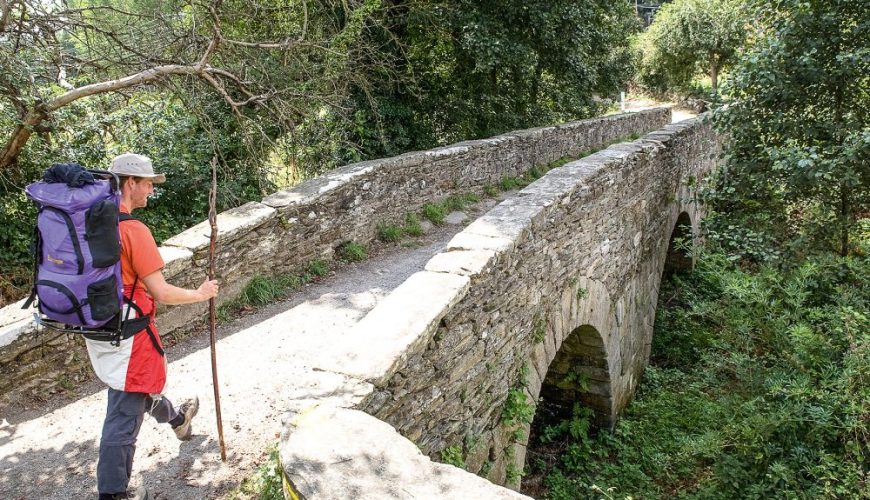
Every year, hundreds of thousands of people walk, cycle or travel to Santiago de Compostela in north-west Spain, following a network of paths that has been in use for more than a thousand years. Some are devout Catholics, some are curious walkers, some are grieving or at a crossroads in life, and many cannot explain exactly why they came. What they share is the experience of a long, slow journey on foot or by bike, with a clear goal and an open mind.
For English-speaking travellers the Camino has a particular pull. The 2010 film The Way, starring Martin Sheen, and books by authors from Paulo Coelho to Shirley MacLaine and Hape Kerkeling put the pilgrimage in front of a global audience. Today the Pilgrim Office in Santiago records visitors from well over a hundred countries, with large numbers from the United States, the United Kingdom, Ireland, Canada and Australia.
This guide explains the history and meaning of the Camino, compares the main routes, covers practical matters such as credentials, accommodation and seasons, and looks at three ways to travel: independently, with a guided programme or by e-bike. Through sportmeeting.de you can compare Spain journeys from German specialist operators including Olimar, Lernidee (active and e-bike tours) and Studiosus (cultural tours).
In this guide
- The Camino at a glance
- History: from an apostle’s tomb to a living pilgrimage
- Why people walk: the meaning of the Camino
- The main routes compared
- The Camino Francés stage by stage
- Other routes: Portuguese, Northern, Primitivo, English and Via de la Plata
- Arriving in Santiago de Compostela
- Three ways to travel: independent, guided and by e-bike
- Credentials, the Compostela and the rules
- When to go, and the Holy Year of 2027
- Practical advice: gear, accommodation, health and money
- Getting there from overseas
- Booking securely from abroad
- Plan your pilgrimage on sportmeeting.de
1. The Camino at a glance
| Feature | Details |
| Destination | Santiago de Compostela, Galicia, north-west Spain; the cathedral holds the tomb of St James the Apostle |
| Names | Camino de Santiago, Way of St James, Jakobsweg (German), Chemin de Saint-Jacques (French) |
| Symbols | The scallop shell and the yellow arrow |
| Most popular route | Camino Francés, from Saint-Jean-Pied-de-Port in France, about 780 to 800 km |
| Other routes | Portuguese, Northern, Primitivo, English, Via de la Plata and coastal variants |
| Minimum for the certificate | Last 100 km on foot or horseback, or last 200 km by bicycle |
| World Heritage | The Camino Francés and the northern routes in Spain are UNESCO-listed; so is the old town of Santiago |
| Ways to travel | Walking, cycling, e-bike, guided walking, cultural tours, section by section |
| Best seasons | Spring (April to June) and autumn (September and October) |
2. History: from an apostle’s tomb to a living pilgrimage
The Camino begins with a tradition. According to it, St James the Greater, one of Christ’s twelve apostles, was executed in Jerusalem in the first century, and his followers carried his body by sea to Galicia. Around the year 813 a hermit is said to have discovered the tomb, guided by a star. The name Compostela is often explained as field of stars, although linguists debate the origin.
The discovery came at a time when the Christian kingdoms of northern Spain were fighting for survival against Muslim rule in the south. The cult of James gave them a powerful symbol, and Santiago quickly became one of the three great Christian pilgrimage destinations, alongside Jerusalem and Rome.
| Period | Development |
| About 813 | Traditional discovery of the tomb; cult of St James begins in Galicia |
| 10th and 11th centuries | Growing pilgrim traffic from across Europe; roads, bridges and hospices built |
| 12th century | Golden age: the Codex Calixtinus, an early pilgrim guide, is compiled; the Romanesque cathedral rises |
| Late Middle Ages | Continued popularity; a network of monasteries and hospitals supports travellers |
| 16th to 19th centuries | Decline through the Reformation, wars and the Enlightenment |
| 20th century | Revival of the routes; the Council of Europe names the Camino the first European Cultural Route; UNESCO recognition |
| Since the 2000s | Rapid growth through books, films and word of mouth; several hundred thousand pilgrims a year |
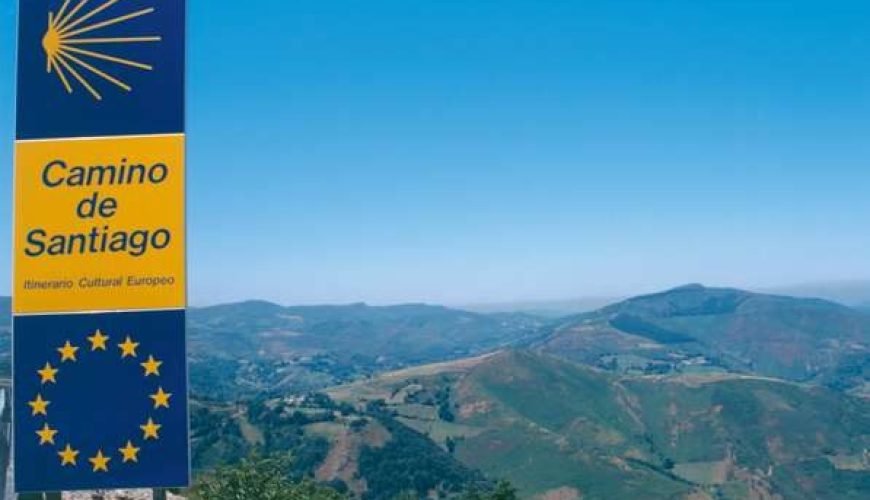
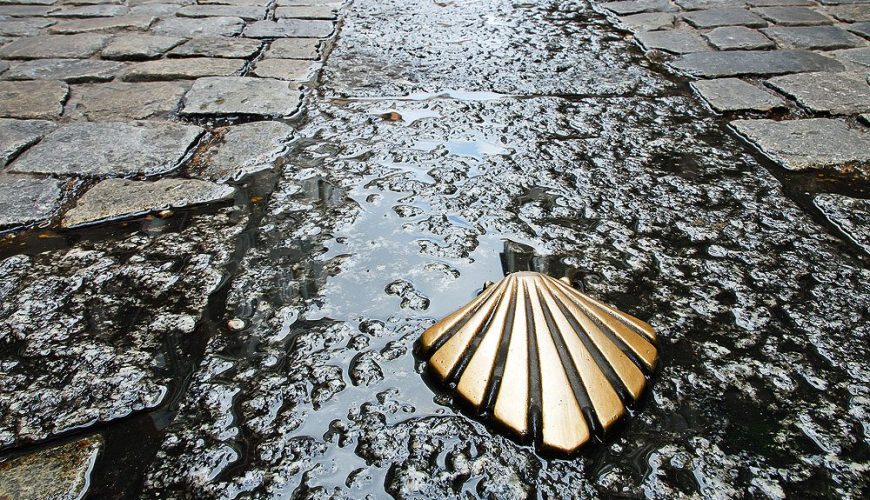
The yellow arrows that mark the way today are a modern invention, popularised in the late 20th century by a Spanish priest who helped revive the Camino Francés. The scallop shell, by contrast, is ancient: medieval pilgrims carried it as proof that they had reached Santiago.
3. Why people walk: the meaning of the Camino
There is no single reason to walk the Camino, and the Pilgrim Office statistics reflect this. A large share of pilgrims give religious or religious-and-cultural motives; many others cite cultural, sporting or personal reasons. In practice the motives overlap, and they often change along the way.
| Motive | What pilgrims seek |
| Religious and spiritual | Prayer, ritual, silence; connection with a tradition that is more than a thousand years old |
| A pause in life | Time to think after loss, divorce, redundancy, retirement or a milestone birthday |
| Physical challenge | Walking day after day; testing stamina and discipline |
| Landscape | Pyrenees, vineyards, the high Meseta, green Galicia, the Atlantic coast |
| Culture and history | Romanesque and Gothic architecture, medieval towns, regional food and wine |
| Community | Friendships formed on the trail; shared meals; stories from every country |
| Simplicity | Living with a small pack and few possessions |
On the Camino you discover how little you need and how much the people around you matter.
Many pilgrims describe the rhythm of the walk as the real transformation: rise early, walk, eat, rest, sleep. That simple pattern clears space for thoughts that daily life normally crowds out.
4. The main routes compared
There is no single Camino but a network of routes converging on Santiago. The best choice depends on how much time you have, your fitness and the experience you want.
| Route | Approx. length | Start | Character |
| Camino Francés | 780 to 800 km | Saint-Jean-Pied-de-Port, France | The classic route; Pyrenees, Pamplona, Rioja, Burgos, the Meseta, León, Galicia; well supported with many hostels |
| Camino Portugués | About 620 km from Lisbon; about 240 km from Porto | Lisbon or Porto | Second most popular; gentler terrain; mild climate; coastal variant |
| Camino del Norte | About 820 km | Irún, Basque Country | Atlantic coast; beaches, fishing villages and hills; more demanding |
| Camino Primitivo | About 320 km | Oviedo | The oldest route; mountainous and quiet; challenging |
| Camino Inglés | About 120 km | Ferrol or A Coruña | Short route that meets the 100 km rule; good for limited time |
| Vía de la Plata | About 1,000 km | Seville | The longest route; Andalusia to Galicia; solitary and hot |
| To Finisterre and Muxía | About 90 km beyond Santiago | Santiago | Continuation to the Atlantic coast; for many the symbolic end of the world |
| Which route should I choose?
First-time pilgrims usually choose the Camino Francés for its infrastructure and the sense of company. If time is short, walk the last 100 km from Sarria or take the English Way. The Portuguese Way suits those who prefer a milder climate and fewer crowds. Experienced walkers seeking solitude often choose the Primitivo or the Vía de la Plata. |
5. The Camino Francés stage by stage
The Camino Francés begins at Saint-Jean-Pied-de-Port at the foot of the Pyrenees and runs for roughly 780 to 800 km to Santiago. It divides naturally into sections, each with its own character.
| Section | Highlights | Character |
| Pyrenees to Pamplona | Crossing the Pyrenees; Roncesvalles; Pamplona old town | Demanding opening; green landscape; many pilgrims |
| Navarre and La Rioja | Puente la Reina; Estella; Logroño; Rioja vineyards | Vineyards and medieval villages; a comfortable rhythm |
| Burgos and the Meseta | Burgos Cathedral (UNESCO); the vast high plateau of Castile | Open skies, silence and sun; for many the inner stage |
| León and Astorga | León Cathedral; Gaudí’s palace in Astorga; Cruz de Ferro | Cultural highlights; approach to the mountains |
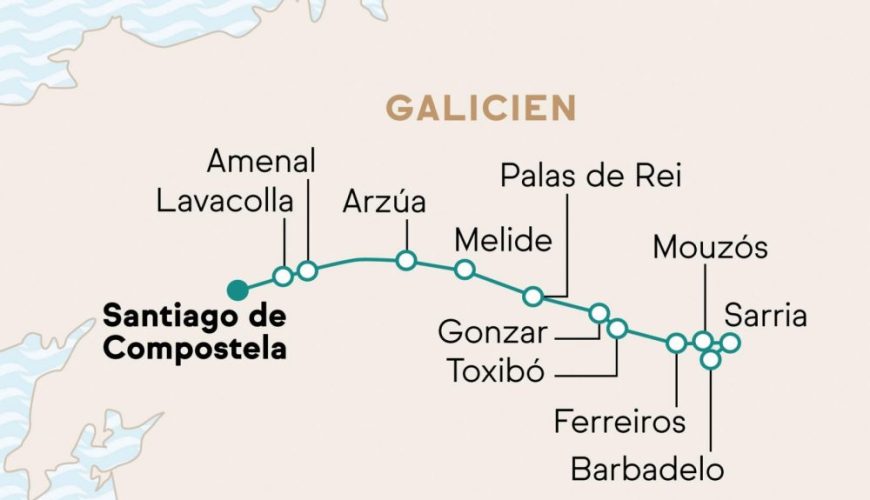
| Galicia | O Cebreiro; Sarria; green hills; eucalyptus and oak; Santiago | Shorter stages; damper weather; many short-distance pilgrims after Sarria |
Stages typically run between 20 and 30 km. The full route takes most walkers around 30 to 35 days. Many pilgrims walk it in sections over several years. The last stretch from Sarria, about 115 km, is particularly popular because it meets the 100 km requirement for the certificate.
6. Other routes: Portuguese, Northern, Primitivo, English and Via de la Plata
Camino Portugués
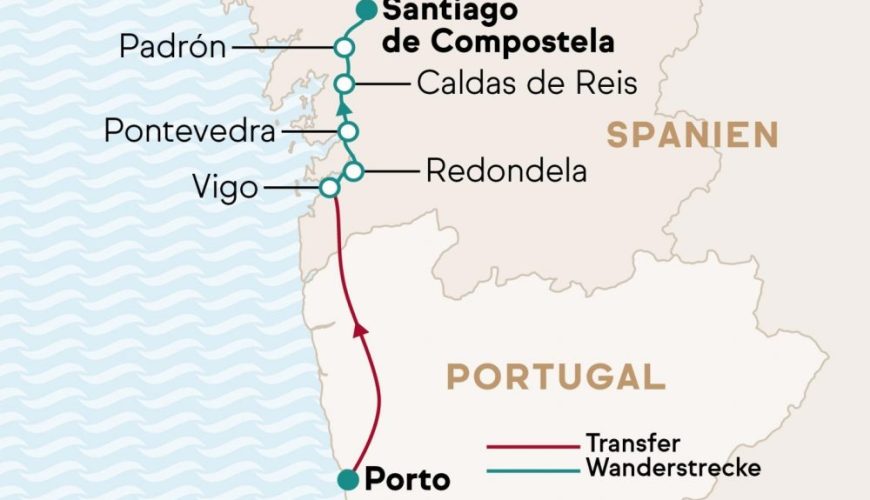
The Portuguese Way starts in Lisbon or, more commonly, in Porto, about 240 km from Santiago. It crosses green countryside, villages and small towns and is gentler and quieter than the Camino Francés. A coastal variant follows the Atlantic. Many first-timers, families and pilgrims short on time choose this route.
Camino del Norte
The Northern Way starts at Irún on the French border and follows the Bay of Biscay through the Basque Country, Cantabria and Asturias. It offers beaches, fishing towns and mountains, together with some of Spain’s best food, but its many climbs make it harder than the Camino Francés.
Camino Primitivo
The Primitivo is traditionally considered the oldest Camino: King Alfonso II of Asturias is said to have walked it in the ninth century to see the newly discovered tomb. Starting in Oviedo, it crosses mountains and quiet valleys, and is physically demanding.
English Way and Finisterre
The English Way, from Ferrol or A Coruña, is about 120 km and just meets the 100 km minimum. Beyond Santiago, many pilgrims continue to Finisterre on the Atlantic coast, which medieval people believed to be the end of the known world.
7. Arriving in Santiago de Compostela
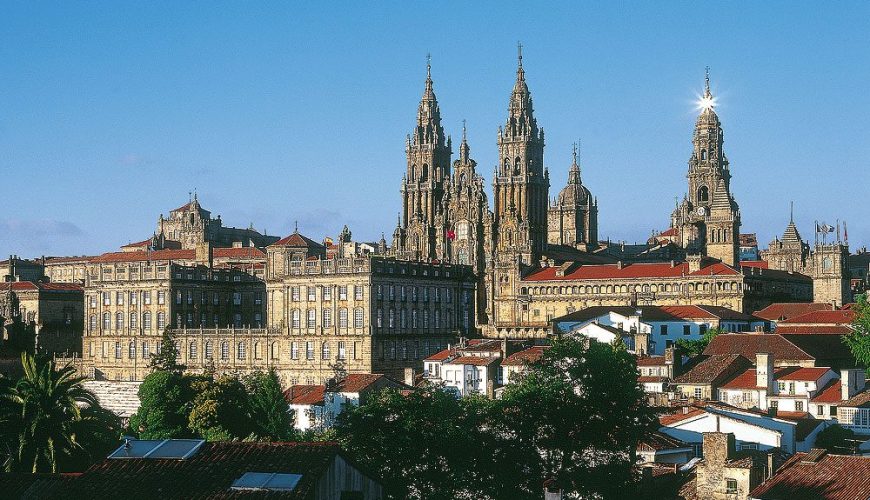
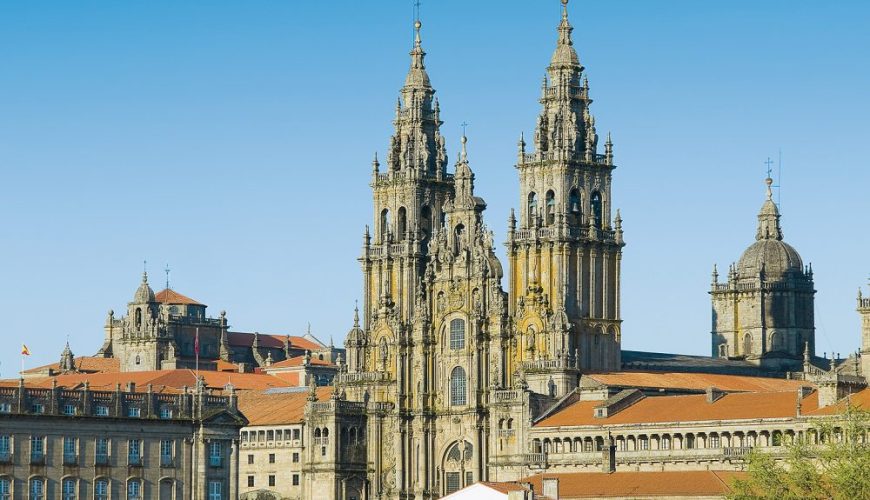
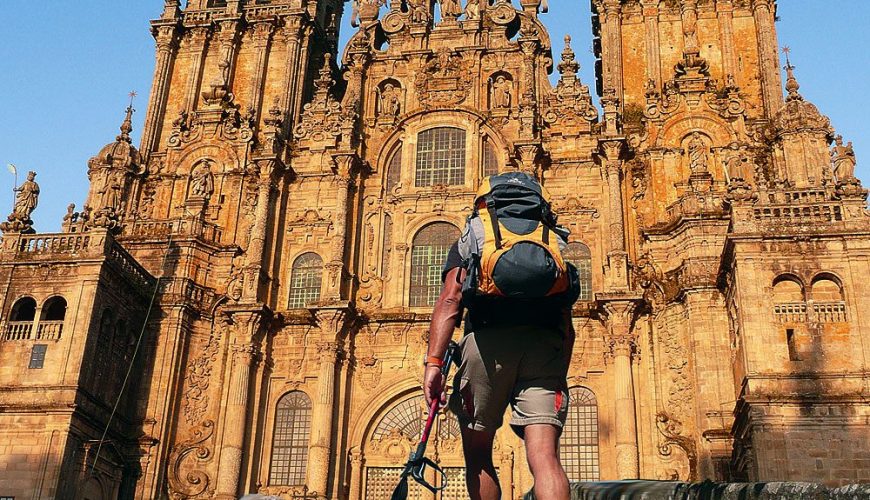
Arriving in Santiago is an emotional moment for many pilgrims. On the Praza do Obradoiro in front of the cathedral you will see people lying on the stones, embracing, crying or simply sitting in silence. The Baroque facade, the Romanesque Portico of Glory inside and the tomb beneath the high altar are the destination of the whole journey.
- Pilgrims’ Mass: A daily Mass in the cathedral during which the origins of arriving pilgrims are announced; on selected occasions the giant incense burner, the Botafumeiro, swings across the transept (not daily; check schedules in advance)
- Pilgrim Office: Here pilgrims present their stamped credential and receive the Compostela certificate
- Old town: A UNESCO World Heritage site with lanes, squares, a historic university and many restaurants
- Finisterre and Muxía: Popular continuation for those who want to see the Atlantic
- Galician food: Pulpo (octopus), empanadas, Padrón peppers, Tarta de Santiago (almond cake) and Albariño white wine
8. Three ways to travel: independent, guided and by e-bike
| Way to travel | How it works | Best for |
| Independent walking | You plan stages, book beds, carry your pack or arrange luggage transfer; maximum flexibility and lowest cost | Experienced walkers; flexible schedules; those who like spontaneity |
| Guided or packaged walking | An operator books hotels, arranges luggage transfer and transfers, and provides route notes or guidance | Pilgrims who value comfort and organisation; first-timers with limited time |
| E-bike and cycling | Cycle sections of the Camino with e-bike assistance; accommodation and luggage often arranged | Active travellers; those who want to cover more ground; pilgrims with joint problems |
| Cultural tour | Coach and walking programme with expert guides visiting Burgos, León, Santiago and other pilgrimage towns | Culture-minded travellers who want history and art rather than daily distance |
Operators available through sportmeeting.de
| Operator | Typical format | Suited to |
| Olimar | Package and Spain holidays; stage or combination journeys with hotel accommodation, transfers and organisation | Pilgrims who want comfort and structure, and who may walk selected sections |
| Lernidee | Active journeys including e-bike tours; cycling along pilgrim routes; cultural context | Cyclists and e-bike riders; active pilgrims covering longer distances |
| Studiosus | Cultural tours of northern Spain with expert guides; Burgos, León, Santiago and other pilgrim towns; art and history focus | Travellers who want to understand history and architecture |
| Check the programme details
Programmes differ widely. Before booking, check how much walking or cycling is involved each day, whether luggage transfer is included, what accommodation is booked, and whether you will reach the minimum distance for the Compostela. Offers and dates are listed in the database on sportmeeting.de. |
9. Credentials, the Compostela and the rules
The pilgrim credential
The credential, or pilgrim passport, identifies you as a pilgrim and gives access to pilgrim hostels. Along the way you collect stamps (sellos) from hostels, churches, cafés and town halls. On the last 100 km, two stamps per day are normally expected. You can get a credential from pilgrim associations, at many starting points, and at some cathedrals.
The Compostela
The Compostela is the official certificate issued by the Pilgrim Office in Santiago. You qualify by completing at least the last 100 km on foot or horseback, or the last 200 km by bicycle, carrying a fully stamped credential, and stating a religious or spiritual motive. Pilgrims with other motives can receive a different certificate recording the distance. Rules can change, so check the current requirements with the Pilgrim Office before you travel.
10. When to go, and the Holy Year of 2027
| Month | Weather and character | Suitability |
| March | Cool and changeable; few pilgrims; some hostels closed | For experienced walkers only |
| April and May | Mild, green, fresh; rain possible; numbers rising | Very good; among the best times |
| June | Warm, long days; less rain; many pilgrims | Very good |
| July and August | Hot, especially on the Meseta; crowded hostels; many Spanish holidaymakers | Only with heat planning |
| September and October | Pleasantly warm; grape harvest; golden landscapes | Very good; second ideal season |
| November to February | Cold, wet, snow in the mountains; many hostels closed | Not advised for first-timers |
| Holy Year (Xacobeo) 2027
When 25 July, the feast of St James, falls on a Sunday, Santiago celebrates a Holy Year (Xacobeo). In these years pilgrim numbers rise sharply and special ceremonies are held, including the opening of the Holy Door of the cathedral. The next Holy Year is 2027. If you plan to walk that year, book accommodation and organised tours early and expect busy trails. |
11. Practical advice: gear, accommodation, health and money
Gear
- Keep your pack light: a common rule is no more than about 10 percent of your body weight
- Footwear: well worn-in walking shoes or trail runners; never start with new, untested shoes
- Socks: several pairs of breathable material; the best defence against blisters
- Clothing in layers: moisture-wicking shirt, fleece, rain jacket, hat and sunglasses
- Sun protection: high-factor sun cream; the Meseta has long stretches without shade
- Water: carry at least one to two litres; check water points
- First aid: blister plasters, antiseptic, pain relief and personal medication
- Walking poles: they reduce strain on knees, especially on descents
Accommodation
| Type | Description | Cost orientation |
| Public albergue (pilgrim hostel) | Dormitory beds; credential required; communal atmosphere | Usually around EUR 10 to 20 per night |
| Private albergue | More comfort; sometimes smaller rooms; reservations possible | Somewhat higher |
| Pension or hostal | Private room; more privacy | Varies by region and season |
| Hotels and paradores | Higher comfort; some historic buildings | Higher; booking advised |
Health and safety
- Train beforehand: walk regularly for several weeks, including with a loaded pack
- Prevent blisters: tape early, care for your feet each evening, change shoes if needed
- Beat the heat: start early, avoid midday sun, drink plenty
- Do not overreach: shorter stages and arriving fit beat heroic days and injury
- Insurance: check travel and medical cover for Spain; consider cancellation insurance
- Emergencies: dial 112 anywhere in Spain
- Walking alone: the Camino is generally considered safe; take normal precautions in remote sections and after dark
Money and practicalities
- Currency: euros; cash is useful in villages, cards are widely accepted in towns
- Phone: a local or EU-friendly SIM or eSIM saves roaming charges; coverage is good on most routes
- Power: Spain uses 230 volt sockets with Type C and F plugs; visitors from the USA, UK, Canada and Australia need an adapter
- Entry rules: check passport and visa or electronic travel authorisation requirements for your nationality well before departure
- Luggage transfer: services carry packs between stops for a fee; useful if you want to walk with a day pack
12. Getting there from overseas
| Destination | Airport | Notes |
| Santiago de Compostela | SCQ Santiago-Rosalía de Castro | Connections via Madrid, Barcelona, London and other hubs; many pilgrims fly home from here |
| Camino Francés start | Biarritz, Bilbao or Pamplona; then bus or rail | Saint-Jean-Pied-de-Port is reached via Bayonne or Pamplona |
| Camino Portugués | Porto or Lisbon | Porto has many international connections and is close to the Galician border |
| Return | From Santiago or via Madrid | Book early for the summer and Holy Years |
| From | Typical routing | Notes |
| USA and Canada | Direct or one-stop flights to Madrid, then onward to Santiago; or via London or Lisbon | Consider arriving a day early to recover from jet lag |
| UK and Ireland | Direct flights to Santiago, Porto, Bilbao and Madrid | Low-cost carriers serve several Camino airports |
| Australia and New Zealand | One-stop via the Gulf, Asia or Europe to Madrid or Porto | Allow extra time for recovery before walking |
| Asia | One-stop via the Gulf or a European hub to Madrid, Porto or Santiago | Check visa requirements early |
13. Booking securely from abroad
| Secure booking on sportmeeting.de for international pilgrims
Package travel booked through German operators is covered by the EU Package Travel Directive (2015/2302) and German travel law, including mandatory insolvency protection through a certificate (Sicherungsschein). Because the operator is based in the EU, key protections apply to the contract regardless of your nationality: refund rights if the operator cancels or significantly changes the trip, and protection of your payments if the operator becomes insolvent. Payments: Online payments are SSL/TLS encrypted and processed by certified providers. Prices are in euros. If your card charges foreign transaction fees, consider a card without them, and tell your bank that you will be travelling. Before booking, read the terms, cancellation periods and what is included: luggage transfer, meals, number of stages, level of difficulty. Individually booked items such as separate flights or hostel beds are not covered by package-travel rules in the same way. Consider travel insurance covering medical care and cancellation. |
14. Plan your pilgrimage on sportmeeting.de
Whether you want to walk a short final section, cycle part of the route on an e-bike, or visit the great pilgrimage cities with an expert guide, sportmeeting.de lets you compare Spain journeys from German specialist operators in one place. Check dates, duration, services and prices, and book online.
| Camino and Spain journeys on sportmeeting.de
On sportmeeting.de you can compare: – Olimar: Spain journeys with organisation, transfers and accommodation – Lernidee: active journeys and e-bike tours; cycling pilgrim routes – Studiosus: cultural tours of northern Spain with expert guides – Dates, duration, services and prices side by side Booking is secure and protected under EU travel law, with an insolvency certificate (Sicherungsschein). Holy Year 2027: book early. -> Find your Camino journey on sportmeeting.de |
The Camino does not ask you to be a hero. It asks you to keep walking, to carry little, to talk to strangers and to pay attention. Many pilgrims return home changed in ways that are hard to describe and impossible to forget. If you are ready to begin, sportmeeting.de is the place to start planning.
Comment (0)