




MOSELLE VALLEY | KOBLENZ TO TRIER | WINE | ROMANS | CASTLES | E-BIKE | RIVER CRUISES | GERMANY
The Romantic Moselle: Koblenz to Trier by Wine, Castle, Boat and E-Bike
Steep slate vineyards, half-timbered wine towns, fairytale castles and 2,000 years of Roman history along one of Europe’s most beautiful river valleys. A complete guide to the German Moselle: the best villages, wine culture, romantic hotels, food, boat trips, e-bike routes and the best time to go.
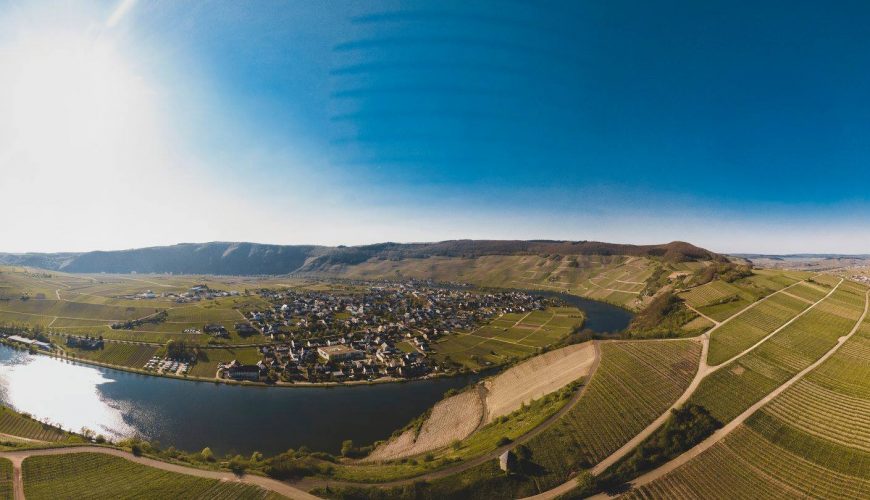
The Moselle, or Mosel in German, winds through western Germany in great looping bends between Trier and Koblenz, carving a valley so narrow and steep that vineyards cling to slopes of up to 60 degrees and more. In the valley below, wine villages of half-timbered houses crowd the riverbank, castles crown the ridges and church spires rise over slate roofs. It is one of the best places in Europe for a slow, romantic holiday, and one of the easiest: the river runs through the valley like a signpost, and you can follow it by boat, on foot, by train or on an e-bike.
The stretch between Koblenz and Trier, roughly 195 kilometres by river, packs an unusual range of experiences into a compact area. At the western end lies Trier, founded by the Romans more than two thousand years ago and home to some of the finest Roman monuments north of the Alps. At the eastern end lies Koblenz, where the Moselle meets the Rhine at the famous Deutsches Eck. In between come the great wine towns of Bernkastel-Kues, Traben-Trarbach and Cochem, the cliff-top castle at Eltz, the Roman wine presses of Piesport and some of the steepest vineyards in the world.
This guide covers the highlights: wine culture, the prettiest wine towns, Roman heritage including the famous Roman wine ship of Neumagen, castles, boat excursions, an e-bike tour along the Moselle cycle path, romantic hotels, regional food and drink, and the best time to visit. You can also compare cycling holidays, river cruises and round trips along the Moselle in the database at sportmeeting.de/Rundreisen.
In this guide
- The Moselle at a glance
- Why the Moselle is so romantic
- The route from Koblenz to Trier
- Wine culture: Riesling, slate and steep slopes
- The prettiest wine towns
- Roman Moselle: Trier, wine presses and the Neumagen wine ship
- Castles and palaces
- Boat trips and river cruises
- E-bike tour along the Moselle cycle path
- Romantic hotels and stays
- Food and drink
- Best time to visit
- Getting there and getting around
- Booking safely
- Plan your Moselle trip on sportmeeting.de
1. The Moselle at a glance
| Feature | Details |
| River | The Moselle (Mosel in German), a tributary of the Rhine; flows from France through Luxembourg and Germany |
| Section covered | Trier to Koblenz, roughly 195 km by river |
| Wine region | Mosel wine region, one of Germany’s oldest and most famous; about 8,500 hectares of vineyards |
| Main grape | Riesling, planted on more than half of the vineyard area |
| Soil | Blue and grey Devonian slate that stores heat and gives the wines their mineral character |
| Steepest vineyard | The Calmont near Bremm, among the steepest vineyards in Europe, with slopes up to about 68 degrees |
| Roman heritage | Trier, founded as Augusta Treverorum; UNESCO World Heritage Roman monuments; Roman wine presses along the river |
| Cycle path | Moselle Cycle Path (Moselradweg), mostly flat and well signposted along the river |
| Boat trips | Sightseeing boats and river cruises, mainly April to October |
| Best seasons | Spring blossom (April to May), summer, and wine harvest (September to October) |
2. Why the Moselle is so romantic
Many European valleys are beautiful. The Moselle is romantic, and the difference lies in the scale. The valley is intimate: the river is not too wide, the slopes rise close on both sides, and every bend reveals a new village, a castle ruin or a church tower. Nothing is far away, so a day can contain a vineyard walk, a boat trip and a long dinner, all within sight of the water.
| Romantic ingredient | On the Moselle |
| Scenery | Terraced vineyards on steep slate slopes; the river looping through great bends |
| Villages | Half-timbered houses, cobbled squares, wine cellars and flower-filled window boxes |
| History | Roman Trier, medieval castles, Art Nouveau villas and ancient wine presses |
| Slow travel | River cruises, vineyard walks and bike paths without steep climbs |
| Wine and food | Riesling tasting in family-run estates; seasonal wine taverns; regional cooking |
| Evenings | Terraces on the river bank, lit castles and quiet streets after the day-trippers leave |
On the Moselle you don’t visit the vineyards. You live among them: they are outside your window, on your plate and in your glass.
3. The route from Koblenz to Trier
Travelling upstream from Koblenz to Trier, or downstream in the other direction, you pass a sequence of towns and landmarks. The table lists the main stops with approximate distances from Koblenz.
| Stop | Approx. distance from Koblenz | Highlights |
| Koblenz | 0 km | Deutsches Eck where Moselle meets Rhine; Ehrenbreitstein Fortress; old town |
| Moselkern and Burg Eltz | About 30 km | Fairytale castle hidden in a forested valley; walking trails |
| Cochem | About 50 km | Reichsburg castle, old town, wine and mustard traditions |
| Beilstein | About 65 km | Tiny, picturesque village below a ruined castle; often called the Sleeping Beauty of the Moselle |
| Zell | About 85 km | Wine town known for Zeller Schwarze Katz wine; riverside promenade |
| Traben-Trarbach | About 110 km | Art Nouveau architecture, Mont Royal ruins, wine cellars, Buddha Museum |
| Bernkastel-Kues | About 125 km | Medieval market square, Landshut Castle ruin, the famous Doctor vineyard |
| Trittenheim and Neumagen-Dhron | About 145 to 160 km | Moselle loop viewpoint; Neumagen wine ship; one of Germany’s oldest wine towns |
| Piesport | About 165 km | Roman wine press; Goldtröpfchen vineyard |
| Trier | About 195 km | Roman monuments, cathedral, Karl Marx House, wine bars |
Distances are approximate and vary between the road, the cycle path and the river, which makes many loops. Check route details on current maps.
4. Wine culture: Riesling, slate and steep slopes
Wine has been grown on the Moselle since Roman times, and the river is one of the most famous wine regions in the world. The key to its character is the combination of slate soil, steep south-facing slopes and a northern climate. The dark slate stores the sun’s heat during the day and releases it at night; the river reflects light onto the vines; and the cool climate lets Riesling ripen slowly, which preserves acidity and produces wines of great delicacy.
What makes Moselle Riesling special
- Lightness: Many Moselle Rieslings have lower alcohol than wines from warmer regions, often between 8 and 11 percent in the Kabinett and Spätlese styles
- Minerality: The slate soil gives a distinctive stony, smoky and mineral character
- Acidity and fruit: Notes of green apple, peach, lime and citrus, with a lively, refreshing acidity
- Range: From bone-dry (trocken) to fruity-sweet and noble dessert wines (Beerenauslese, Trockenbeerenauslese, Eiswein)
- Ageing: The best Rieslings from steep sites can age for decades, developing honeyed, petrol-tinged complexity
Understanding German wine terms
| Term | Meaning |
| Trocken | Dry |
| Halbtrocken (feinherb) | Off-dry |
| Kabinett | Light, delicate wine from fully ripe grapes; often a gentle introduction |
| Spätlese | Late harvest; riper and richer; can be dry or sweet |
| Auslese and above | Very ripe selected grapes; usually sweeter, sometimes dessert-style |
| Erste Lage and Grosse Lage | Top vineyard classifications, indicating especially fine sites |
| Weingut | Wine estate |
| Straußwirtschaft | Seasonal wine tavern run by a winemaker, serving the estate’s own wine with simple food |
The Calmont: Europe’s steepest vineyard
Near the village of Bremm, in a great loop of the river, the Calmont vineyard climbs at gradients of up to about 68 degrees. Harvesting here is done entirely by hand, often by workers roped to the slope. A marked trail, the Calmont Klettersteig, leads through the vineyard with fixed ropes and ladders, making it a popular challenge for experienced walkers. It is a vivid reminder of how much work goes into every bottle.
| How to taste wine on the Moselle
Many estates welcome visitors for tastings, often in a historic cellar or a pretty courtyard. Book ahead for groups, expect to taste several wines, and spit if you are driving or cycling. Ask for the estate’s dry Riesling and a Kabinett, and you will understand the range of the region within a few glasses. Many estates sell directly and can ship wine home. |
5. The prettiest wine towns
| Town | What makes it special | Don’t miss |
| Bernkastel-Kues | Often called the heart of the Middle Moselle; a medieval market square with half-timbered houses | The Spitzhäuschen (Pointed House); Landshut Castle ruin above the town; the Doctor vineyard, one of Germany’s most famous |
| Cochem | Romantic town below a hilltop castle; lively promenade and narrow lanes | The Reichsburg, rebuilt in the 19th century in neo-Gothic style; a chairlift for views; boat trips |
| Beilstein | Tiny, almost untouched village with steep lanes and a ruined castle | Burg Metternich ruin; evening walk when the day-trippers have gone |
| Traben-Trarbach | Twin towns joined by a bridge; rich Art Nouveau (Jugendstil) architecture | Mont Royal ruins; wine cellars; Buddha Museum |
| Zell | Relaxed wine town on a river bend; flat promenade | Wine tastings; the Black Cat legend |
| Trittenheim | Classic Moselle loop with vineyards on both sides | Viewpoints over the loop; wine estates |
| Neumagen-Dhron | Considered one of Germany’s oldest wine-growing places | The Neumagen wine ship, a Roman stone relief and its modern replica |
| Piesport | Famous for its amphitheatre of south-facing vineyards | Roman wine press; the Goldtröpfchen vineyard |
| Ediger-Eller and Valwig | Smaller villages with quiet charm | Wine estates and walks through the vineyards |
6. Roman Moselle: Trier, wine presses and the Neumagen wine ship
The Romans arrived on the Moselle in the first century BC and stayed for centuries. They founded Trier, built roads and bridges, and planted the first vineyards on the slate slopes. Much of that heritage survives, and it makes the valley as interesting for history lovers as for wine drinkers.
Trier: Germany’s oldest city
Trier, founded around 16 BC as Augusta Treverorum, claims to be Germany’s oldest city. At its peak in the 4th century it was one of the largest cities of the Roman Empire and an imperial residence. Several of its monuments form a UNESCO World Heritage Site.
| Monument | What it is |
| Porta Nigra | The great Roman city gate, from the 2nd century; the best-preserved Roman city gate north of the Alps |
| Amphitheatre | Roman arena where gladiator fights and animal hunts were staged; large enough for many thousands of spectators |
| Imperial Baths (Kaiserthermen) | Remains of a vast bathing complex from the 4th century, with underground service tunnels |
| Basilica of Constantine | Imperial throne hall; one of the largest surviving single-room Roman buildings, now a Protestant church |
| Roman Bridge | The oldest bridge in Germany, resting on Roman stone piers |
| Cathedral and Church of Our Lady | Among the oldest churches in Germany, with Roman foundations |
| Rheinisches Landesmuseum | Museum of Roman finds, including the original Neumagen wine ship relief |
| Karl Marx House | Birthplace of Karl Marx, born in Trier in 1818 |
Roman wine presses
The Romans did not just plant vines, they built wine presses. Along the Moselle you can still see the foundations of several Roman wine-pressing sites, including at Piesport, Erden, Brauneberg and Lösnich. At Piesport you can walk through the remains of a large Roman pressing complex and imagine grapes pressed by foot and beam presses two thousand years ago. The sites show how long the Moselle has been a wine region, and how much the Romans valued it.
The Neumagen wine ship
One of the best-known Roman finds on the Moselle is the Neumagen wine ship, a stone relief carved around the year 220 AD. It was found in 1878 at Neumagen and shows a Roman cargo ship loaded with wine barrels and manned by rowers, with a carved wine-skin beside the steersman. The relief was part of a tomb monument for a wine merchant, and it is the most famous image of Roman wine trade on the river. The original is in the Rheinisches Landesmuseum in Trier; a copy stands in Neumagen. A full-size replica of the ship, called Stella Noviomagi, was built in the 1980s and has sailed on the river.
| Connecting Roman and wine
A good way to combine the two themes: spend a day in Trier with the Roman monuments, then the next day cycle or take a boat along the river to Neumagen and Piesport, where you can see the wine ship, visit the Roman press and taste wine from the same slopes. |
7. Castles and palaces
The Moselle is lined with castles, from perfectly preserved medieval fortresses to romantic ruins. They guard the river bends and the old trade routes, and many have views as striking as their architecture.
| Castle | Location | What to know |
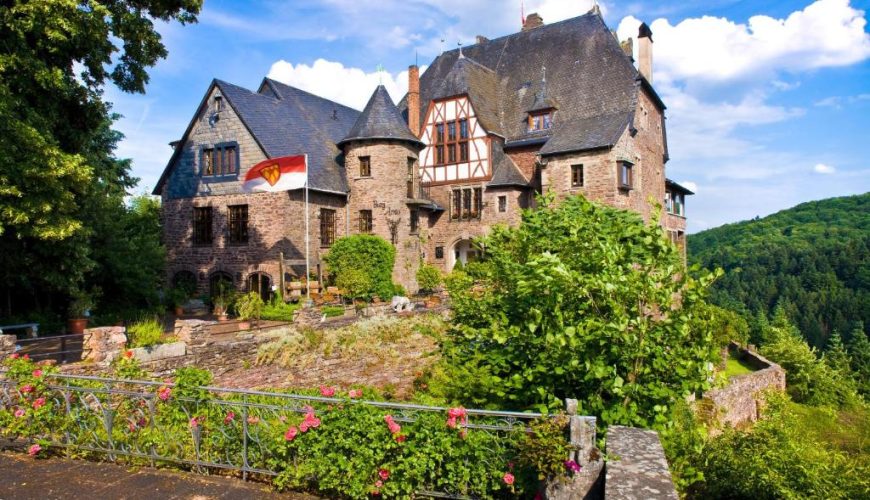
| Burg Eltz | Near Moselkern | A medieval castle hidden in a wooded side valley; never destroyed; still owned by the same family for centuries; a fairytale silhouette with turrets and half-timbered upper floors |
| Reichsburg Cochem | Cochem | Hilltop castle above the town; destroyed by French troops in the 17th century and rebuilt in the 19th century in neo-Gothic style; guided tours and views |
| Burg Thurant | Near Alken | A castle with twin towers on a hill above the river; hiking trails and views |
| Burg Metternich | Beilstein | Ruin above a tiny village; steep climb; romantic views over the roofs |
| Marienburg | Pünderich | Former convent and castle on a hillside above the vineyards |
| Landshut Castle | Bernkastel-Kues | Ruin above the town with views over the Moselle and the vineyards |
| Mont Royal | Traben-Trarbach | Remains of a large fortress built by the French in the 17th century |
| Ehrenbreitstein Fortress | Koblenz | Large fortress across the Rhine from the Deutsches Eck; reachable by cable car |
| Visiting Burg Eltz
Burg Eltz is reached by a walk from the car park or shuttle bus, or on foot from the village. It is among the most visited castles in the area, so go early in the day or later in the afternoon, and check current opening times and tour rules before you travel. |
8. Boat trips and river cruises
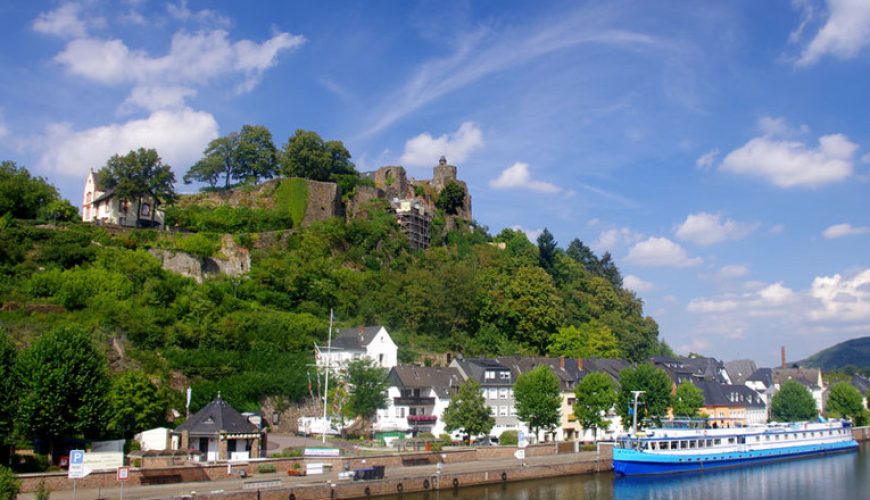
Seeing the Moselle from the water is one of the best ways to experience the valley. Boats glide past vineyards and villages at walking pace, and a journey along the river reveals perspectives that a car cannot. There are two main options: short sightseeing trips and longer river cruises.
| Option | What it is | Good for |
| Sightseeing boat trips | Short trips of one to several hours, usually between April and October; departures from towns such as Cochem, Zell, Bernkastel-Kues, Traben-Trarbach and Trier | A relaxed day on the water; combining boat and bike or train |
| Point-to-point boat links | Boats between neighbouring towns, sometimes combined with a return by train or bus; schedules vary by season | Hiking or cycling one way, returning by boat |
| Wine and dinner cruises | Evening trips with wine tasting or meals on board; available on selected dates | Romantic evenings |
| Multi-day river cruises | Cruises on the Moselle, often combined with the Rhine, with overnight stays on board and guided excursions | Travellers who want to unpack once and see many places |
Timetables, routes and operators change from year to year. Check current schedules locally and book popular departures in summer and autumn ahead.
9. E-bike tour along the Moselle cycle path
The Moselle Cycle Path (Moselradweg) is one of Germany’s most popular long-distance cycle routes. It follows the river on quiet roads, vineyard tracks and dedicated cycle paths, is largely flat and is well signposted. That makes it ideal for e-bikes, which take the effort out of occasional headwinds or small hills and let you enjoy the scenery.
| Stage (example) | Approx. distance | Highlights |
| Trier to Neumagen-Dhron or Bernkastel-Kues | About 50 to 60 km | Roman Trier, Mosel loops, Roman wine presses, Neumagen wine ship |
| Bernkastel-Kues to Traben-Trarbach and Zell | About 45 to 55 km | Wine villages, vineyards, Art Nouveau architecture |
| Zell to Cochem | About 40 to 45 km | Beilstein, Moselle loops, castles |
| Cochem to Koblenz | About 50 to 55 km | Burg Eltz area, Moselkern, arrival at the Deutsches Eck |
A complete Trier to Koblenz route takes four to seven days at a relaxed pace, depending on how many stops and detours you make. Many organised cycling holidays offer luggage transfer between hotels, so you ride with a day pack, and some include boat trips or tastings. Distances here are approximate.
E-bike tips
- Battery: Plan your daily range and charge in your hotel overnight; carry the charger or ask about charging points
- Tyres and gears: The path is mostly paved, but some sections use gravel; a trekking bike is ideal
- Direction: Many cyclists ride from Trier to Koblenz, which follows the river downstream, but either direction works
- Trains and boats: Regional trains and boats run along the valley, so you can shorten a stage or return by public transport; check bike rules and booking requirements
- Wine and cycling: Spit at tastings, drink water and take a break; local wine is strong enough to ruin the ride
- Seasons: Spring and autumn are especially pleasant; in summer, start early to avoid heat and crowds
| Organised e-bike holidays
If you prefer not to plan the route yourself, a number of German cycling and active-holiday operators offer Moselle e-bike tours with hotels, luggage transfer and route notes. You can compare cycling holidays and round trips along the Moselle in the database at sportmeeting.de/Rundreisen. Check dates, stages, daily distances and included services for each offer. |
10. Romantic hotels and stays
The Moselle offers romantic accommodation in many forms, from castle hotels and wine-estate guesthouses to half-timbered inns and Art Nouveau villas. Most are small and personal, with the owner often behind the reception desk or pouring wine.
| Type of stay | What to expect | Good for |
| Castle and palace hotels | Historic buildings with elegant rooms and gardens; often a restaurant and spa | Special occasions, anniversaries |
| Wine-estate guesthouses | Rooms or apartments at a working winery; breakfast, tasting and views of the vines | Wine lovers; a personal experience |
| Half-timbered town hotels | Historic houses in the centre of a wine town; cosy rooms; restaurants downstairs | Short city-style breaks along the river |
| Riverside hotels | Rooms with views of the Moselle; terraces and promenades at your door | Romantic evenings by the water |
| Wellness hotels | Spa and wine-themed treatments (vinotherapy); swimming pools; quiet atmosphere | Relaxation and couples’ weekends |
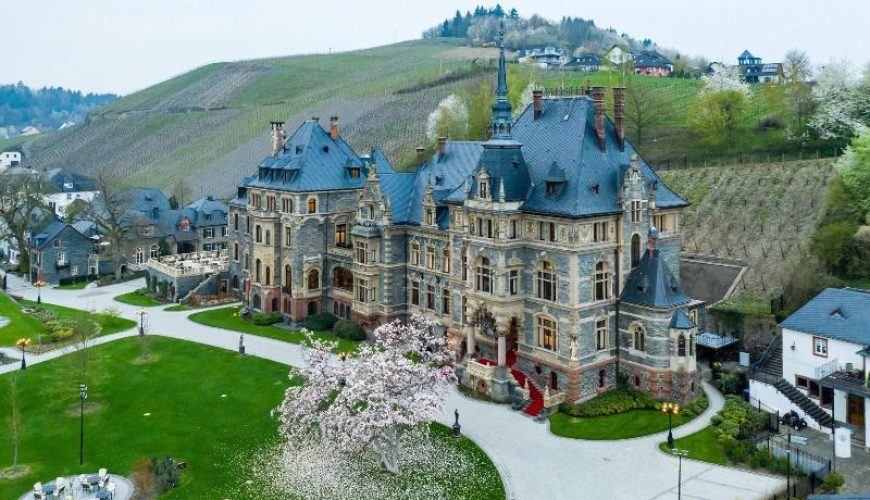
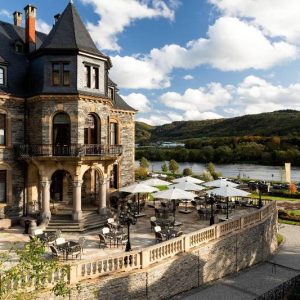
Well-known examples of romantic stays include Schloss Lieser, a castle hotel near Bernkastel-Kues, and the Weinromantikhotel Richtershof in Mülheim. Treat these as starting points and check current offers and details. Book early for summer weekends, the harvest season and the Christmas markets.
| Choosing where to stay
For a first visit, base yourself in one of the central wine towns such as Bernkastel-Kues, Traben-Trarbach or Cochem, from where you can reach vineyards, castles and boat landings easily. If you ride a long cycle route, plan a new overnight stop each day. |
11. Food and drink
The food of the Moselle is hearty, regional and designed to go with Riesling. Many dishes rely on potatoes, pork, river fish, onions and local vegetables, served in wine taverns, village inns and family restaurants.
| Dish or drink | What it is |
| Riesling | The classic Moselle wine, from dry to sweet; ask for a local estate wine by the glass |
| Rieslingsekt | Sparkling wine made from Riesling; a refreshing aperitif |
| Federweißer and onion tart | In early autumn: partly fermented young wine with onion tart (Zwiebelkuchen) |
| Dippekuchen | A rustic baked potato dish, traditional in the region |
| River fish in Riesling sauce | Local fish cooked in a wine sauce |
| Hunsrück ham and sausages | Regional cured meats served with bread and mustard |
| Winzervesper | A winemaker’s platter of cold cuts, cheese and bread, eaten with the estate’s wine |
| Straußwirtschaft | A seasonal tavern at a wine estate serving its own wines and simple food, often in courtyards and garden terraces |
| Eiswein | Sweet wine made from grapes harvested frozen; a rare winter treat |
Upscale restaurants and Michelin-starred kitchens add modern cooking to the mix, often with menus matched to estate wines. Many towns also have bakeries, delis and markets selling local specialities.
12. Best time to visit
| Season | Character | Highlights |
| April and May | Fresh and green; vine buds and blossom; fewer visitors | Cycling, walks, first boat trips of the season |
| June to August | Warm, long days; busy; the valley at its liveliest | Wine festivals, evening terraces, river cruises; book ahead |
| September and October | Wine harvest; golden vineyards; mild days | Federweißer, harvest festivals, vineyard walks; often the best time |
| November to December | Quiet and atmospheric; mist over the river; Christmas markets | Markets in Trier, Cochem and elsewhere; cosy hotels |
| January to March | Cold and quiet; many places closed or on reduced schedules | Ice wine; quiet stays; limited boat trips |
| Our recommendation
For romance, wine and good weather, the best months are May, June, September and early October. For the harvest atmosphere and golden colours, choose late September to mid-October. For quiet and bargains, visit in spring or November. |
13. Getting there and getting around
| By | Details |
| Train | Koblenz and Trier both have good rail connections; a regional train runs along the Moselle between them, taking around two hours or a little more; check timetables |
| Plane | Nearest major airports include Frankfurt, Cologne/Bonn, Düsseldorf and Luxembourg, which is close to Trier; from Frankfurt to Koblenz expect around one to two hours by train or car |
| Car | Motorways link both ends of the valley; the roads along the river are scenic but slow; parking in small towns can be limited |
| Boat | Sightseeing boats and river cruises on selected stretches, mainly April to October |
| Bike | The Moselle Cycle Path follows the river; bike hire and e-bike stations are common in towns |
| On foot | Many walking trails climb from the villages into the vineyards; the Moselhöhenweg and Moselsteig are popular long-distance routes |
Without a car, the Moselle is easy: use trains and boats to move between towns, and walk or cycle from your hotel. With a car, you gain flexibility for castles and small villages but should plan parking and avoid drinking and driving.
14. Booking safely
| Payment security for package and individual bookings
Organised cycling holidays, river cruises and round trips are normally package holidays, which are covered by the EU Package Travel Directive (2015/2302) and German travel law, including insolvency protection through a certificate (Sicherungsschein). Check that you receive it, and read the terms and cancellation periods. Hotels, restaurants, boat tickets and wine tastings booked individually are not packages, so different rules apply: confirm cancellation terms and deposits in writing. Currency and cards: prices are in euros; cards are widely accepted in towns, but small wine estates and taverns may prefer cash. Travel insurance covering medical care and cancellation is advisable. |
15. Plan your Moselle trip on sportmeeting.de
The Moselle rewards slow travel: a boat trip one day, a vineyard walk the next, a castle in the afternoon, a long dinner in the evening. If you want to compare cycling holidays, river cruises and round trips along the Moselle, the database at sportmeeting.de/Rundreisen lets you check destinations, dates, durations and prices in one place.
| Moselle and Germany round trips: sportmeeting.de/Rundreisen
In the database at sportmeeting.de/Rundreisen you can compare: – E-bike and cycling holidays along the Moselle and other German rivers – River cruises and round trips in Germany and Europe – Cultural and wine-themed tours with guided visits – Walking and active holidays – Dates, durations, services and prices side by side Tip: check daily distances, luggage transfer, hotel categories and what is included in each offer. Booking is secure and protected under EU travel law where a package holiday applies. -> Find your Moselle trip on sportmeeting.de/Rundreisen |
Romantic Moselle Valley Journey
A tailor-made journey through Germany’s history, castles, wine regions and beautiful historic cities
The Moselle is a valley for people who want to slow down: to follow a river, taste a wine where it grew, stand in a Roman monument and then watch the light go down over the vineyards. Whether you travel by boat, bike, train or on foot, the valley offers more than you can see in a single trip, and that is a good reason to come back. On sportmeeting.de, the planning begins.
Comment (0)