

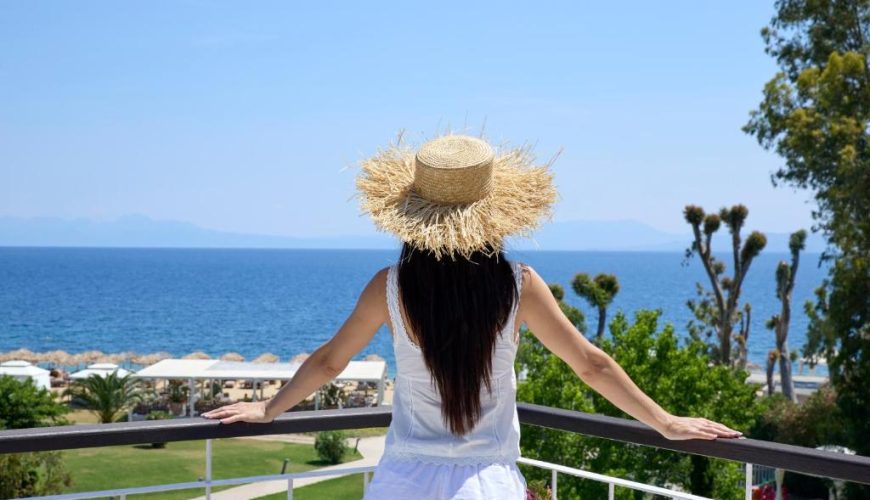
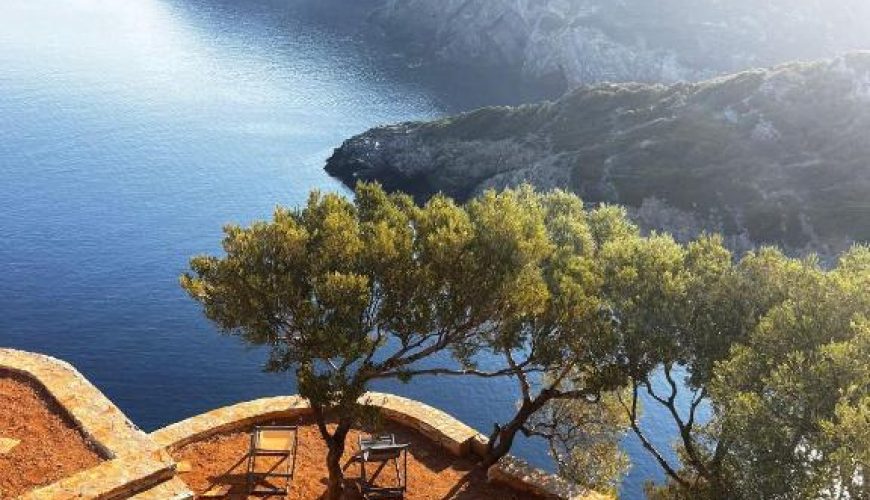
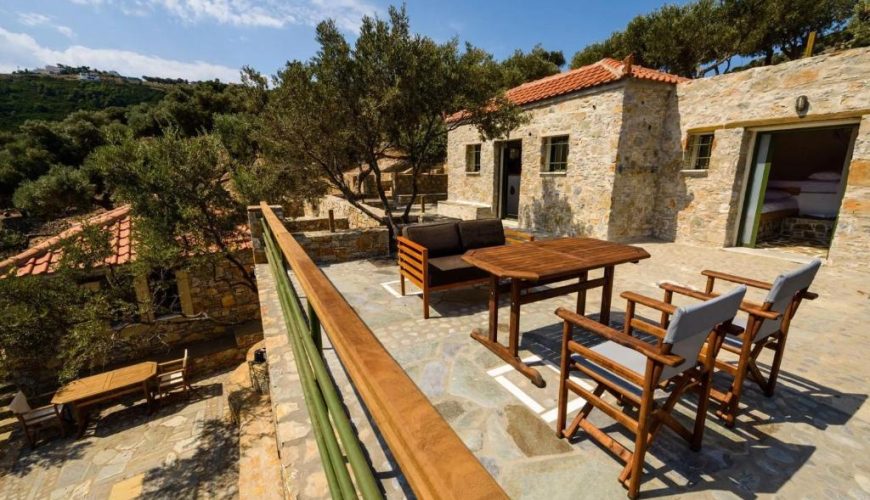
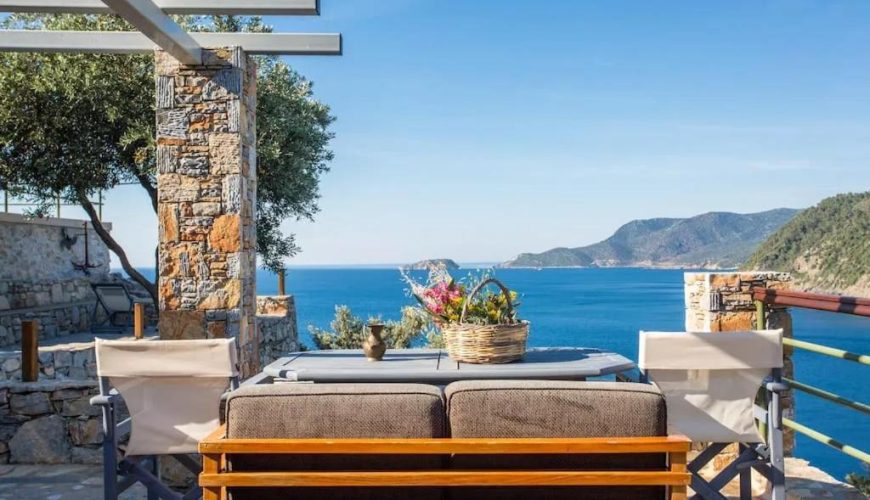
Northern Sporades · Greece · Summer 2026 · Island Hopping · Aegean
Skiathos, Skopelos, Alonissos and Skyros — the four islands of the Northern Sporades are Greece’s most densely forested archipelago. Pine forests reaching the shore, turquoise water, Europe’s largest marine park and the filming locations of Mamma Mia. The lush green alternative to the Cyclades.
Why the Northern Sporades are different
Most people arrive in Greece with a mental image already formed: whitewashed cube houses stacked up a clifftop, a blue-domed church, bare volcanic rock and a blazing Cycladic sun. It is a beautiful image. But it is only one of Greece’s many faces.
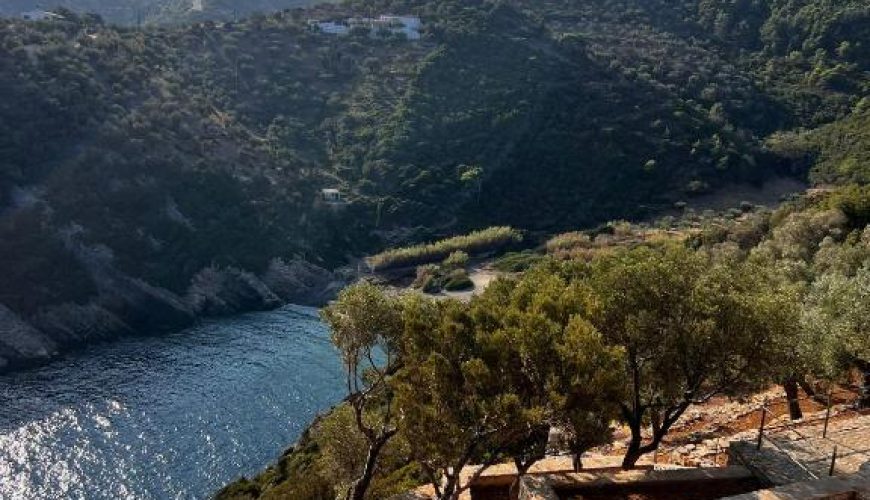
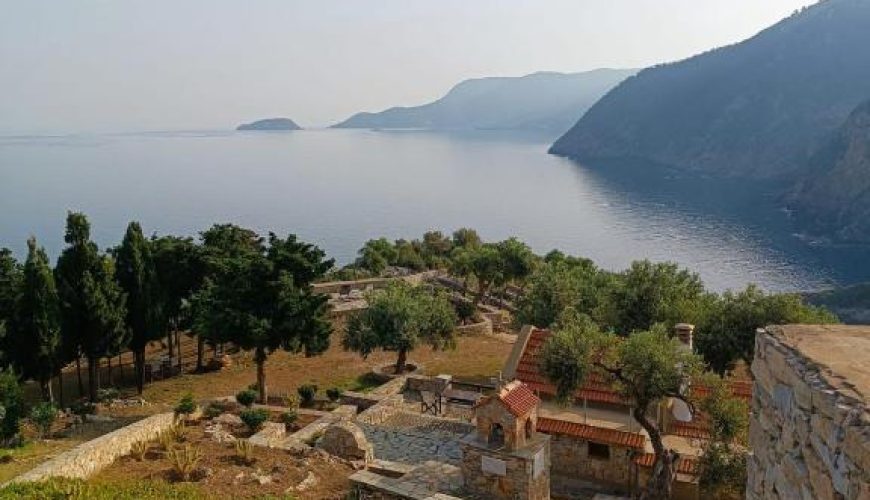
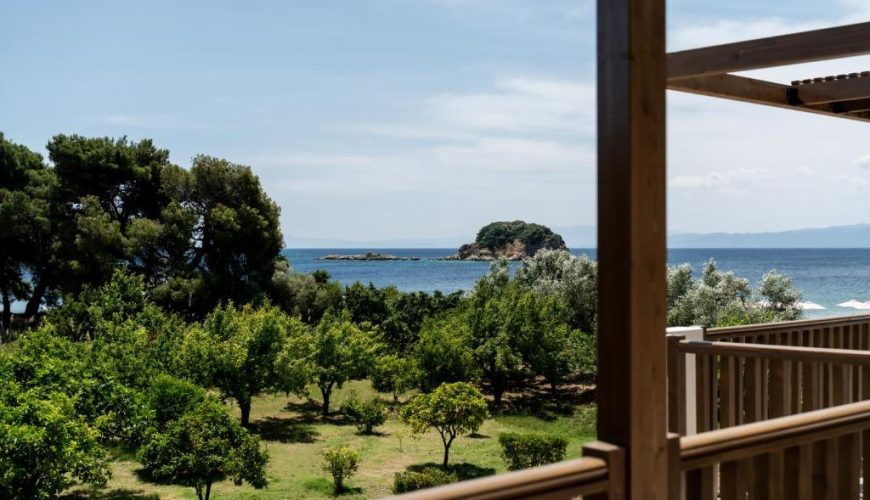
The Northern Sporades look completely different. The four inhabited main islands — Skiathos, Skopelos, Alonissos and Skyros — lie off the Thessalian coast of central Greece and are covered in dense pine and fir forests that in many places sweep directly down to the water’s edge. Instead of bare rock and whitewashed walls, what dominates here are green hillsides, ancient olive groves, wild coves filled with turquoise water and traditional architecture with slate rooftops. This is the Aegean that package tourists don’t always find.
“What continues to fascinate about this archipelago is the combination of relaxation and active holidays on the finest sand beaches in central Greece — with unparalleled natural experiences that can be found on every island, just a short distance from the tourist centres.”
The 2008 musical film Mamma Mia, shot largely on Skiathos and Skopelos, introduced the islands to a global audience. Fans still come looking for the filming locations, and they do exist — but what they usually discover is that the islands have far more to offer than a film backdrop: Europe’s largest marine park, one of the world’s rarest marine mammals, hiking trails through pine forests, ancient archaeological sites and a kitchen rooted in fishing and small-scale farming that produces some of the finest olive oil and cheese in Greece.
Northern Sporades – the essentials at a glance
- Location: Aegean Sea, off the Thessalian coast of central Greece
- Main islands: Skiathos (48 km²), Skopelos (96 km²), Alonissos (65 km²), Skyros (209 km²)
- Character: Dense pine and fir forests, gentle green hillsides, turquoise water — the lush green alternative to the Cyclades
- Highlights: National Marine Park of the Northern Sporades (Europe’s largest, 2,200 km²), Mediterranean monk seal, Mamma Mia filming locations
- Language: Greek; good English on Skiathos and Skopelos; some German and Swedish spoken too
- Currency: Euro
- Best time to visit: May/June and September/October (shoulder season)
Skiathos – over 60 beaches on 48 square kilometres
Northern Sporades · Central Greece
Skiathos
Skiathos is the smallest and most-visited of the Northern Sporades, covering just 48 square kilometres. Arriving here — whether by ferry or via the island’s famously thrilling airport, whose runway measures only 1,628 metres and ends directly above the sea — you feel the island’s energy immediately: lively, green, beach-obsessed and carrying the kind of lightness that the southern Aegean islands rarely match.
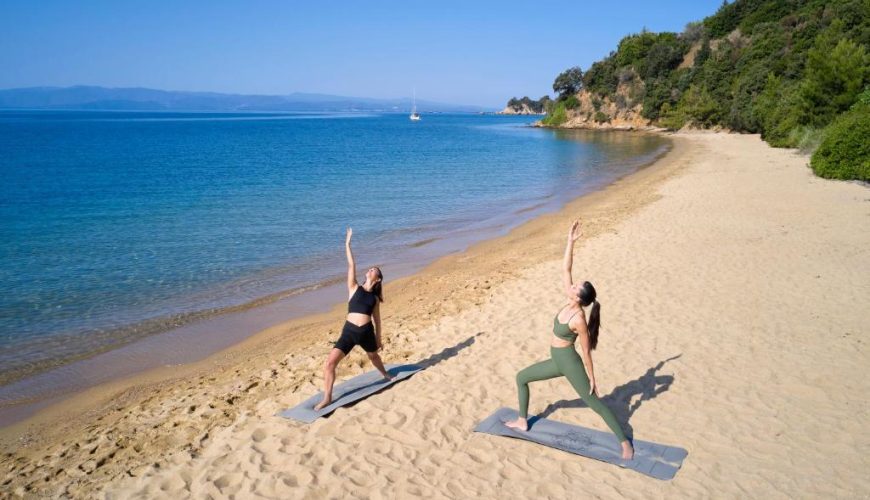
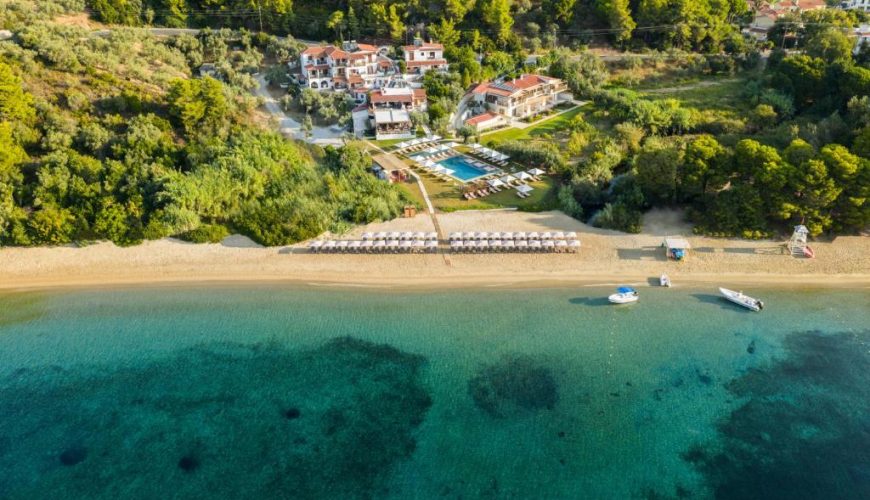
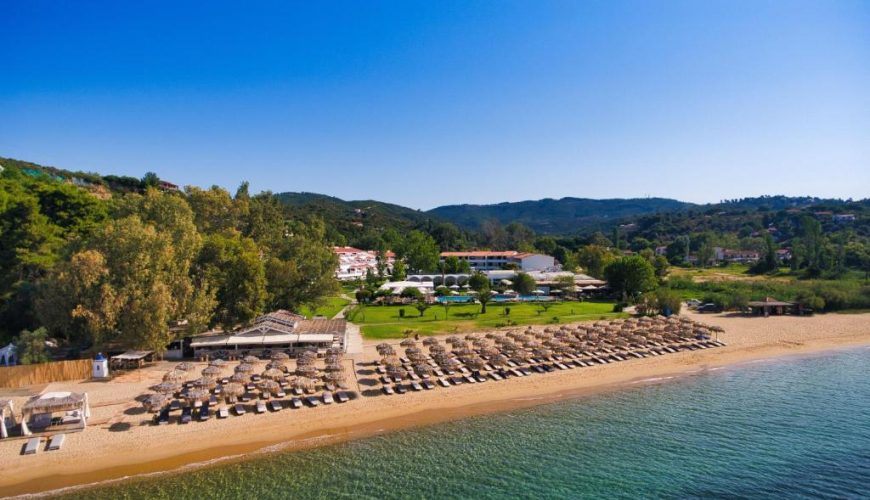
Despite its modest size, Skiathos has over 60 beaches, ranging from wide stretches of golden sand to intimate turquoise pebble coves. The most celebrated is Koukounaries — a broad sandy beach backed by ancient pine forest and frequently cited as one of the most naturally pristine beaches in the entire Mediterranean. Behind the pines lies the quiet lagoon of Strofylia, home to over 200 bird species. The dramatic Lalaria Beach in the island’s northeast is a different proposition entirely: accessible only by boat, it consists of blinding white pebbles, sheer cliffs framing natural rock arches, and water of an extraordinary clarity.
The Old Harbour of Skiathos Town was used as a filming location for Mamma Mia — this is where the three potential fathers meet for the first time in the film. The town’s open-air cinema near the harbour still screens the film three times a week under the stars, a pleasantly absurd experience whether you’re a fan or not. Beyond the film connection, Skiathos offers the Byzantine monastery of Evangelistria, where Greece’s national flag was first raised in 1807, a genuinely active nightlife scene centred on the Chora, and Banana Beach as the island’s water sports hub for surfers and kite boarders.
Skiathos – top beaches & highlights
- Koukounaries:Wide sandy beach, one of the Mediterranean’s most pristine; behind it, Lake Strofylia with 200+ bird species
- Lalaria Beach:White pebble beach accessible by boat only; spectacular natural rock arches; extraordinary water clarity
- Banana Beach:Water sports centre in the southwest — surf schools, kite, water-skiing; popular with younger visitors
- Kastro:Abandoned medieval fortress town in the north, perched on a steep headland above the sea; accessible by boat or a walk
- Monastery of Evangelistria:Byzantine monastery where the first Greek national flag was raised on 27 November 1807 — historically significant and architecturally striking
- Mamma Mia locations:Old Harbour (the fathers’ meeting scene), Kastani Beach, the open-air cinema in town
- Nightlife:Skiathos Town is the liveliest evening destination in the Northern Sporades — bars along the harbour, clubs, late-night dining
Skopelos – Greece’s greenest island
Northern Sporades · Thessaly · Mamma Mia Island
Skopelos
The name Skopelos derives from the Greek for «rocky cliff» — but the name does little justice to what the island actually looks like. Skopelos is the most densely forested island in Greece. Pine and fir forests cover most of its 96 square kilometres, olive groves cascade down the hillsides, flowering shrubs in purple, white and yellow line the paths, and Skopelos Town (Chora) climbs steeply from the harbour in a tight ensemble of whitewashed houses, slate rooftops and innumerable small chapels.
Most of Mamma Mia was filmed on Skopelos. The film’s most iconic scene — Meryl Streep climbing a steep rocky staircase to a clifftop chapel as she belts out «The winner takes it all», red scarf streaming in the wind — made the small church of Agios Ioannis sto Kastri one of the most photographed sights in the Greek islands. The climb up the 200-odd stone steps is short but steep; the view from the top across the Aegean is worth every one of them.
Beyond the film connection, Skopelos is primarily an island for walkers, nature lovers and those in search of genuine authenticity. Marked trails lead up through the forest to the four monasteries on the Palouki mountain — Evangelistria, Agia Varvara, Metamorfosis and Prodromos — all dating from the 16th to 18th centuries, all set in breathtaking mountain scenery. The island has an estimated 360 to 380 churches and chapels: some tiny and carved into rock faces, others ancient monastic complexes of considerable historical significance. For beach lovers, Panormos, Milia, Kastani and Limnonari are the finest bays.
Skopelos – top highlights
- Agios Ioannis sto Kastri: The Mamma Mia chapel on its rocky headland — unmissable for film fans, equally spectacular for everyone else
- Skopelos Town (Chora): One of Greece’s finest traditional towns — Venetian castle, slate rooftops, over 100 churches, cobbled lanes
- Palouki monastery walk: Full-day hike to four historic hilltop monasteries on marked trail T1 — views over town and sea throughout
- Glossa: The island’s second village, high above the port of Loutraki — more authentic than Chora, with sweeping panoramic views
- Kastani Beach: Also a Mamma Mia filming location, with a famous beach bar that featured in the film
- Milia Beach & Panormos: The finest bays on the west coast — pine trees reaching the shoreline, turquoise Aegean water
- Dolphins: Regularly sighted off Skopelos — guided boat trips available from the harbour
Alonissos – Europe’s largest marine park & the monk seal
Northern Sporades · Marine Conservation Area
Alonissos
“Alonissos puts the crowds off — entirely deliberately.” This line captures the smallest and most original of the three neighbouring Sporades islands precisely. Getting here takes more effort than Skiathos or Skopelos, there is no local airport, no nightlife and noticeably less mass tourism. Those who make the journey are rewarded with the clearest water in the Aegean, untouched coves, a stone-built old town and paths through pine forests leading down to the shore.
The centrepiece of Alonissos is the National Marine Park of the Northern Sporades — at over 2,200 square kilometres, the largest marine protected area in Europe. It was established to protect the Mediterranean monk seal (Monachus monachus), one of the world’s most endangered marine mammals, as well as dolphins, loggerhead sea turtles, fin whales and hundreds of bird species. In 2026, 21 new seal pups were recorded in the park — a historic figure in over 40 years of monitoring.
In Steni Vala, the small harbour in the island’s northeast, the Greek conservation organisation MOm operates a rehabilitation centre for injured seal pups, with a visitor exhibition area covering the monk seal’s biology and the park’s work. Divers travel from across Europe to explore the park’s waters — ancient shipwrecks at accessible depths add an archaeological dimension to what is already one of the finest dive environments in the Mediterranean. The old hilltop town of Chora, abandoned after a 1965 earthquake and later restored in its original style, is a labyrinth of stone lanes, vine-covered houses and extraordinary views.
Alonissos – marine park & highlights
- National Marine Park: 2,200 km² — Europe’s largest marine protected area; home to Mediterranean monk seal, common dolphins, loggerhead turtles, fin whales
- Boat tours from Patitiri: Guided park excursions depart daily at around 10:00 — book directly at the harbour; Zone A is strictly protected and accessible only on designated routes
- MOm Rehabilitation Centre, Steni Vala: Exhibition on the Mediterranean monk seal with photos, videos and conservation background; open in season
- Diving & snorkelling: Some of the clearest, most biodiverse water in the Aegean; ancient wrecks visible at snorkel depth; guided dive excursions from Patitiri
- Alonissos Chora: Restored medieval hilltop town — natural stone architecture, flowering vines, panoramic views across the sea
- Amphora workshop at Tsoukalia: Ruins of an ancient amphorae manufacturing site on the beach — fragments bearing the ancient name Ikyon still visible
- Walking: Coastal paths and forest trails from Patitiri into the hill villages — quiet, well-marked and entirely without mass tourism
Skyros – the forgotten island of the archipelago
Northern Sporades · Central Greece · Independent Character
Skyros
Skyros is the most individual of the four Sporades islands — and by some distance the least visited. It lies geographically separate from the other three, further east in the Aegean, and has an administrative distinction: while Skiathos, Skopelos and Alonissos belong to the Thessaly region, Skyros is administered as part of Central Greece. This gives it a character entirely its own, which expresses itself in landscape, architecture and way of life.
The island divides into two completely different halves. The north is green and forested, with valleys and wooded hills similar to the neighbouring islands. The south reveals a bare, almost lunar mountain landscape of pale rock and scrubland — dramatic and possessed of a beauty that lovers of unspoilt wilderness find extraordinary. Between the two sits Skyros Town (Chora): an unusually tall, almost cyclopean old town that clings to the rock faces below a Byzantine castle, dense and authentic in a way that has few equivalents in the Greek island world.
Skyros is known across Greece for its living folk art tradition: hand-carved furniture in a unique local style, colourful embroidery and painted ceramics have made the island famous well beyond its shores. Many old houses in the Chora are still furnished in the traditional manner and can be visited. Another uniquely Skyrian feature is the Skyros Pony — an ancient dwarf horse breed that still lives semi-wild on the island, closely connected to Greek mythology as a descendant of the horses of Achilles.
Skyros – highlights & distinctive features
- Skyros Town (Chora): Cycladic-style architecture — narrow lanes, Byzantine castle, panorama over two separate seas
- Folk art tradition: Hand-carved furniture (unique Skyros style), embroidery and ceramics — viewable in private homes and the Folklore Museum
- Skyros Pony: Rare dwarf horse breed living semi-wild — occasionally spotted in the south of the island; associated with the mythology of Achilles
- Magazia & Molos Beach: Long sandy beach directly below the Chora — the island’s main swimming area, easily walked from town
- Rupert Brooke’s grave:T he British poet (1887–1915) is buried on Skyros — a pilgrimage site for literary travellers
- Skyros Carnival: One of Greece’s most distinctive folk festivals — the legendary masked Geros figures, whose origins predate Christianity
Island hopping & sailing – experiencing the Sporades as a whole
The Northern Sporades are geographically ideal for island hopping. The distances between Skiathos, Skopelos and Alonissos are small, ferries run regularly and quickly (30 to 90 minutes between islands), and each island is so distinctly different from its neighbours that even a week covering two or three of them delivers more variety than a long stay on a single island would.
A classic sequence for two to three weeks: start on Skiathos (airport, beach life, Mamma Mia locations), continue to Skopelos (hiking, monasteries, the Agios Ioannis chapel), then on to Alonissos (marine park, diving, stillness). Those with time can add Skyros — though reaching it from the other three requires a longer logistical route via Euvia.
Island hopping tips for the Northern Sporades
- Skiathos as the starting point: The only island with an international airport — the natural entry point for all combinations
- Sequence logic: Skiathos → Skopelos → Alonissos moves progressively from lively and touristy to quiet and unspoilt — the natural building arc
- Ferries: Skiathos–Skopelos approx. 60–90 min; Skopelos–Alonissos approx. 30–60 min; Sea Jets currently holds a near-monopoly outside peak season (prices up ~30% since 2024)
- Skyros separately: Accessible by ferry from Kymi on Euboea (approx. 2 hours), or seasonally from Volos/Thessaloniki; combining it with the other three in a single trip requires careful planning
- Sailing: The Sporades are considered one of the finest sailing areas in Greece — short distances, sheltered anchorages, consistent summer winds. Yacht charters available from Volos and Skiathos
- Suggested sailing route: Skiathos → Tsougria (uninhabited islet) → Skopelos → Blue Caves → Alonissos → Peristera (uninhabited island) → return
Getting there – flights, ferries & practical information
Reaching the Northern Sporades is more straightforward than their reputation as a «hidden gem» might suggest — at least for Skiathos and Skopelos. Alonissos and Skyros require slightly more planning but reward travellers with considerably less mass tourism.
| Island | Direct flight | Ferry from mainland | Notes |
|---|---|---|---|
| Skiathos | YES – Airport SKI; direct flights from London, Manchester, Edinburgh, Dublin, Amsterdam, Frankfurt, Munich, Vienna and others | From Volos & Agios Konstantinos (approx. 2–3 hrs); from Thessaloniki seasonally | Short runway (1,628 m) — spectacular low approach over the sea |
| Skopelos | NO – no airport | From Volos & Agios Konstantinos; or ferry from Skiathos (approx. 60 min) | Easiest approach: fly to Skiathos, then take the ferry |
| Alonissos | NO – no airport | From Volos; or ferry from Skiathos (approx. 2–2.5 hrs) or Skopelos (30–60 min) | Most demanding journey of the three; deliberately limits mass tourism |
| Skyros | Small domestic airport (seasonal flights from Athens) | From Kymi (Euboea) – approx. 2 hrs; Kymi approx. 3 hrs bus from Athens | Separate from the other three islands; combining with Skiathos/Skopelos via Volos is possible |
For UK and Irish travellers
Skiathos is served by direct summer flights from London Stansted, Manchester, Edinburgh and seasonally from other UK regional airports, with Ryanair, Jet2 and TUI Airways among the operators. The flight time from the UK is approximately 3 hours 30 minutes. No visa is required for UK passport holders for stays of up to 90 days. Carry your GHIC (Global Health Insurance Card) for access to state healthcare in Greece — apply free via the NHS website before departure.
Best time to visit & tips before you travel
The Northern Sporades have a clear tourist season running from May to October. The summer months are reliably warm and sunny, all ferries and services run at full capacity, and island hopping is at its most practical. But the height of summer comes at a price.
Month by month
- May: Best time for walkers and nature lovers — islands in full spring green, very few tourists, pleasant temperatures (18–24°C), many accommodation prices lower. Some ferry connections still reduced.
- June: Ideal for first-time visitors — summer begins, sea temperatures rising (22–24°C), full ferry and boat trip operation, not yet high-season prices. Highly recommended.
- July / August: High season — beaches busy, prices at their highest, ferries booking out. Skiathos and Skopelos can feel crowded. Alonissos remains quieter. Sea temperatures up to 27°C.
- September: Second-best month — the sea is still warm (25–26°C), crowds have largely gone, prices drop. Hiking in comfortable temperatures. Strongly recommended for a return visit.
- October: Quietest season; many hotels and restaurants close; some ferries no longer run daily. Rewarding for independent travellers and those seeking complete solitude.
10 tips for travelling the Sporades
- Skiathos vs. Skopelos: Want beach life and evenings out? → Skiathos. Want walking, monasteries and authentic village life? → Skopelos. The best trip? Both together.
- Book Alonissos boat tours early: The organised National Marine Park excursions from Patitiri harbour fill up in high season. Arrange your spot as soon as you arrive on the island.
- Visit Agios Ioannis early in the day: The Mamma Mia chapel on Skopelos is heavily visited in summer. An early morning visit (before 09:00) or the evening hour offers the peaceful experience the place deserves.
- Lalaria Beach by boat: The finest beach on Skiathos is accessible only by water. Day boat tours leave from Skiathos harbour; alternatively, hire a small boat (EU driving licence often sufficient).
- Scooter on Skiathos: The best way to reach beaches off the bus route. Check your licence category before hiring; costs vary by season.
- Car-free on Skopelos and Alonissos: Buses and taxis cover the main destinations; mopeds and bicycles are available for hire. Bringing a car is rarely necessary and complicates ferry bookings.
- Book ferries in advance: In July and August, book ferry tickets at least one to two weeks ahead — especially if you need to transport a vehicle. The Sea Jets website allows online booking.
- Plan Skyros separately: Skyros works best as a dedicated trip rather than as an extension of the other three islands. The logistics via Euboea make it awkward to combine without significant travel time.
- A few words of Greek: On Alonissos and Skyros, English is less widely spoken than on Skiathos. A handful of Greek phrases — kalimera (good morning), efharisto (thank you), ena kafé parakaló (a coffee please) — are genuinely appreciated.
- Local olive oil and cheese: All four islands produce excellent local olive oil; Skopelos and Skyros are particularly known for their cheeses. The small shops and morning markets in the harbour towns are the best places to buy — far superior to supermarket versions.
Northern Sporades · Greece · Summer 2026
Four islands.
One archipelago.
Green Greece.
Skiathos, Skopelos, Alonissos and Skyros — Greece’s most unspoilt and most forested island group. Pine forests reaching the sea, turquoise coves, Europe’s largest marine park and the filming locations of Mamma Mia.
Bilder: Dome Island, Princess Resort, Casa Milos
Comment (0)