

TENNIS TRAVEL MAGAZINE
The World’s Best Tennis Resorts: Your Complete Travel Guide
From the ITF-certified courts of Forte Village Sardinia to Quinta do Lago’s high-performance Campus, from Crete’s dual tennis clusters at Nana and Mitsis to La Manga Club’s championship facilities in Spain — this guide covers the finest tennis destinations in Europe and beyond.
For serious tennis players, choosing a holiday destination is never just about the beach or the food — although both matter. What really drives the decision is the quality of the courts, the calibre of the coaching, the variety of playing partners, and whether the facility genuinely caters to players who want to improve rather than just bat a ball around in the afternoon heat. The good news is that Europe’s Mediterranean coastline offers a remarkable concentration of exactly this kind of resort: places where professional-grade courts, former tour players turned coaches, FIT- and ITF-certified facilities and thoughtfully designed programmes have turned the tennis holiday from a pleasant add-on into the entire point of the trip.
This guide covers five of the best: Forte Village in Sardinia, with its 13-court Tennis Star Academy and a coaching roster that has included Grand Slam champions and Wimbledon winners; Quinta do Lago in the Algarve, where The Campus combines elite tennis and padel with a high-performance training culture; the twin tennis clusters of Crete, centred around the Mitsis Royal Mare (formerly Aldemar) with seven sand courts and the Nana Golden Beach complex with 18 courts; and La Manga Club in Murcia, a three-golf-course resort that also hosts 26 tennis courts in one of Spain’s most reliable year-round climates. Whether you are planning a solo coaching week, a group trip with your club, or a family holiday where tennis is the central activity, these five destinations represent the benchmark.
What’s in this guide
- What makes a great tennis resort? A framework for choosing
- Forte Village Resort, Sardinia: the benchmark for tennis academies
- Quinta do Lago, Algarve: The Campus and the high-performance approach
- Crete: two world-class tennis clusters in one island
- Mitsis Royal Mare (formerly Aldemar): seven sand courts and a thalasso spa
- Nana Golden Beach: 18 courts and the Nana Tennis & Sports Club
- La Manga Club, Murcia: 26 courts alongside three championship golf courses
- Comparing the five destinations at a glance
- Tennis travel tips: planning your perfect tennis holiday
1. What makes a great tennis resort? A framework for choosing
Before diving into the individual destinations, it helps to know what to look for — because not all tennis resorts are created equal, and the right choice depends heavily on your level, your goals and who you are travelling with.
Court quality and surface
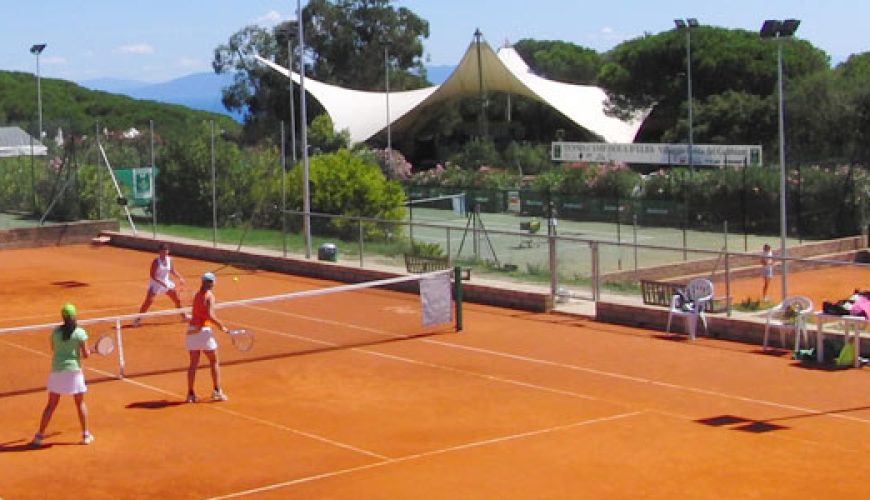
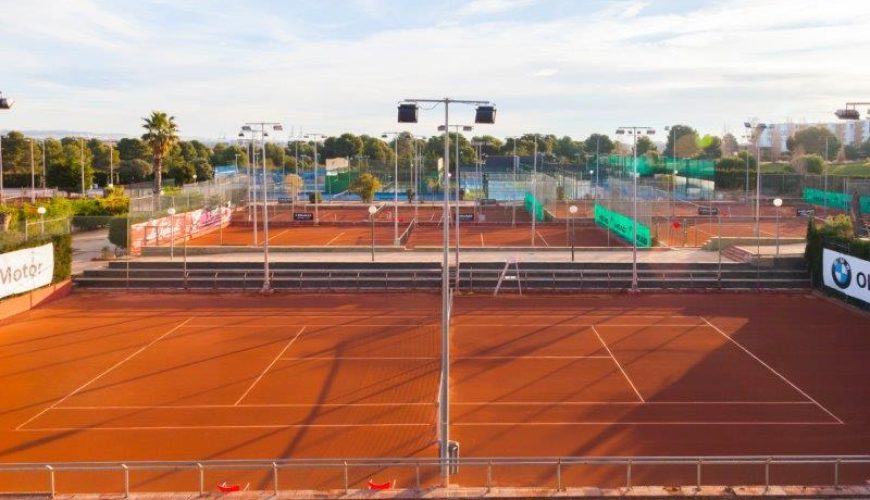
Clay is king across most Mediterranean resorts, and for good reason: its slower pace suits technique-focused play, it is gentler on joints than hard courts, and it rewards tactical intelligence over raw power. Most of the resorts in this guide offer clay as their primary surface, typically red sand or a compressed clay compound. The best facilities complement their outdoor clay courts with at least one indoor or covered court, extending usability beyond peak season and into rainier months. Floodlighting across all courts means the playing day can extend well into the evening — valuable in the height of summer when midday heat makes outdoor play genuinely uncomfortable.
Coaching quality
The single biggest differentiator between a resort with courts and a genuine tennis destination is coaching. The best programmes employ former touring professionals or coaches with verifiable professional-level credentials, offer structured group clinics and individual lessons, and tailor their approach to different ability levels rather than herding everyone into the same group session. Some of the resorts in this guide go further, hosting annual coaching programmes run by Grand Slam champions and top-ranked international professionals — a genuinely rare offer outside of full-time academies.
Playing partners and programme structure
A resort that attracts serious players tends to attract more serious players, creating a self-reinforcing quality cycle. Look for destinations with organised tournaments, structured matchplay formats and social tennis events — these generate playing partners at your own level far more reliably than hoping to find a willing opponent at the bar. Group travel with your own club or coaching group sidesteps this issue entirely, which is why several resorts in this guide have invested specifically in group-booking infrastructure.
The wider resort experience
Equally important for most travellers — especially those travelling with non-playing partners or families — is what happens off the court. Spa and recovery facilities matter particularly for multi-day intensive programmes; pools, beaches and restaurants determine whether the rest of the group is happy; and the overall accommodation standard sets the tone for the whole trip. The best tennis destinations in this guide do all of this well.
2. Forte Village Resort, Sardinia: the benchmark for tennis academies
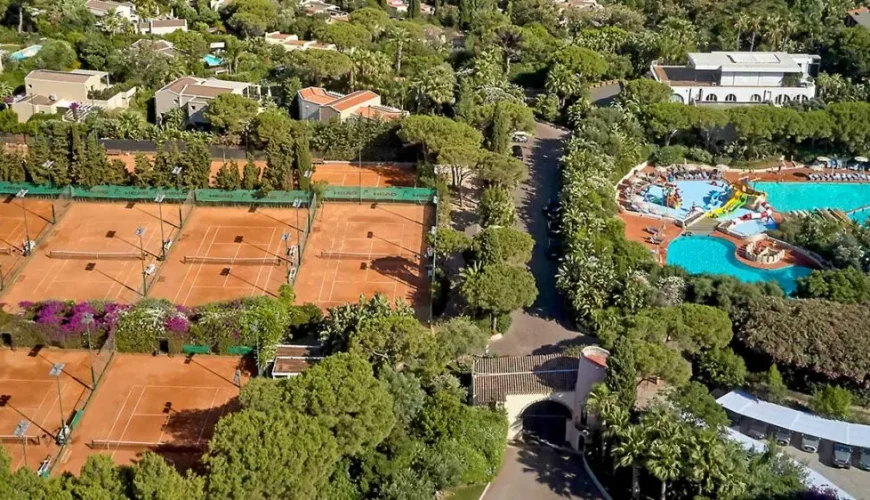
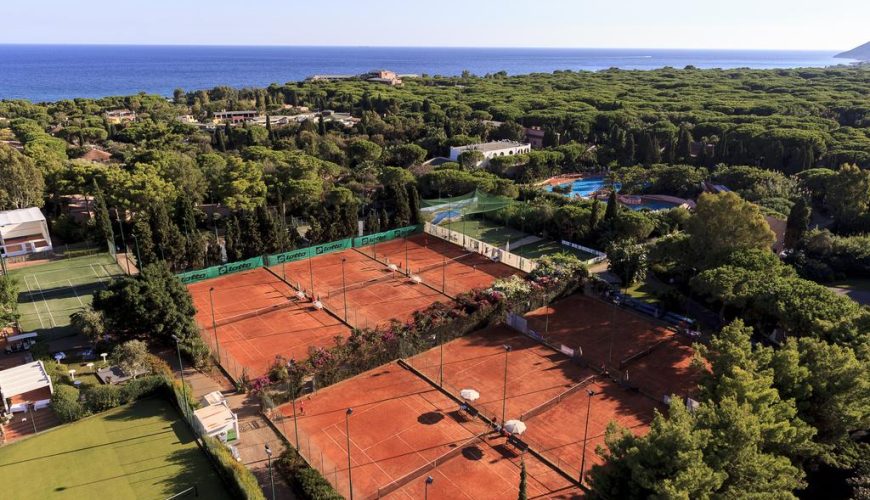
If there is one resort in Europe that has genuinely earned the description ‘the benchmark for international tennis’, it is Forte Village. Set on the south-west coast of Sardinia at Santa Margherita di Pula, roughly 40 kilometres from Cagliari’s Elmas Airport, the resort spreads across 50 hectares of subtropical gardens running directly down to a beach that Forbes has ranked among the 25 most beautiful in the world. Within that setting, the Forte Village Tennis Star Academy by Head has been operating since 2013 with the stated aim of bringing Grand Slam-level coaching to players of all abilities.
The courts: 13 surfaces, all floodlit
Forte Village has 13 courts in total: 12 clay and one hard court, all certified by the FIT (Italian Tennis Federation) and all equipped with floodlighting for night play. This makes the facility large enough to absorb the resort’s full guest complement without pressure on court time, and varied enough to offer hard-court practice for players preparing for tournaments on different surfaces. The resort also hosts ITF tournament circuits — ATP and WTA ranking points have been awarded here — which gives the facility a competitive credibility that most holiday tennis destinations simply cannot claim.
The coaching programme: Grand Slam names on a Mediterranean clay court
The Tennis Star Academy runs from April to October and is built around a core of Italian and international professional coaches, led by head coach Rocco Loccisano, a former top-ranked Australian player with Italian roots and former personal coach to Wimbledon champion Pat Cash. Each season, the programme is supplemented by visiting Grand Slam champions and former tour professionals who run masterclasses and clinics. Past visiting coaches have included players such as Radek Stepanek and Emilio Sanchez.
Programmes run across a five-day format with 90-minute daily lessons, individually or in groups, tailored to level from complete beginner to high-level competitive player. For younger guests, the Junior Tennis Academy Camp provides structured coaching for children alongside the adult programme. Weekly singles, doubles, junior and senior tournaments run throughout the season, giving every guest a competitive outlet regardless of ability.
Group and pre-season training
Forte Village has developed a specific offer for club groups and pre-season training parties. For groups of eight or more, a special package is available in April, October and the second half of March that includes one hour of court time per person per day (at minimum two hours of free play daily for the group), full access to the resort’s pools, beach and wellness facilities, and accommodation in Deluxe Bungalows from around 1,598 euros per person based on triple occupancy. This positions the resort as a serious option for club pre-season training weeks, something that several European clubs already use it for.
Beyond tennis: eight hotels, the Acquaforte Thalasso Spa and a Forbes beach
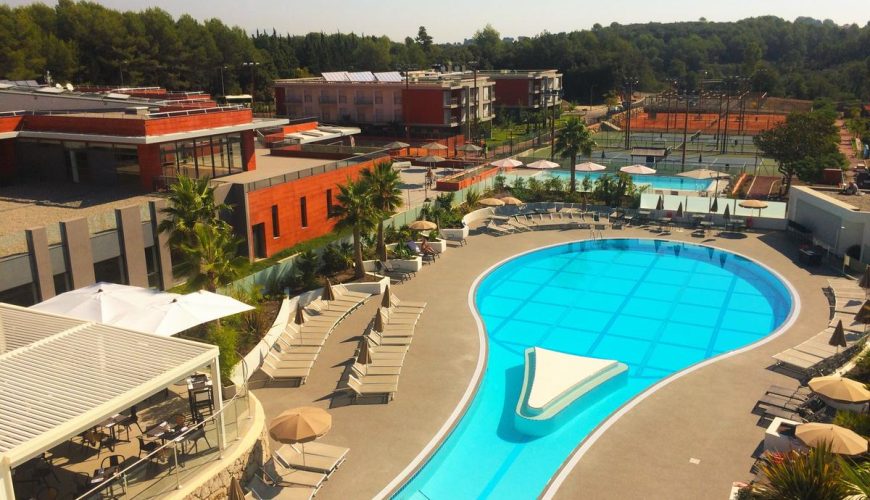
With eight hotels offering 755 rooms and suites in total, Forte Village accommodates groups with widely different budget expectations within the same resort. Accommodation for Tennis Academy guests is typically in Hotel Bouganville, a bungalow-style property set among fragrant Mediterranean garden plants. Recovery infrastructure matches the sporting ambition: the Acquaforte Thalasso & Spa is a member of Leading Spas of the World and specialises in thalassotherapy and seawater-based treatments designed for athletic recovery. Nine pools, 21 restaurants (at peak season), a boutique piazza and evening entertainment complete a resort that functions as a self-contained village — one that happens to have some of the best tennis courts in Europe at its centre.
Anyone who has been to Forte Village once will always want to come back. Rediscovering the places, the people, and the moods that made this experience so vivid and so magnificent.
| Best time to visit for tennis
The Forte Village Tennis Academy season runs from April to October. For pre-season training groups, March/April and October offer the best combination of availability, competitive pricing and ITF tournament schedules. Midsummer (July/August) is peak family season — busier, louder and significantly more expensive. |
Exclusive Tennis, Golf, and MICE Packages at Forte Village
Tennisreisen nach Sardinien – Exklusives Gruppenangebot im Forte Village Resort
3. Quinta do Lago, Algarve: The Campus and the high-performance approach
Quinta do Lago is best known internationally as one of Europe’s premier golf destinations, with three championship courses on a 2,000-hectare estate nestled inside the Ria Formosa Natural Park, 15 minutes from Faro Airport. But the resort’s sporting ambitions extend well beyond golf, and for tennis and padel players, The Campus is the reason to visit.
The Campus: elite sport for everyone
The Campus is Quinta do Lago’s high-performance multi-sports hub, designed to serve everyone from juniors and ambitious amateurs to professional athletes using the facility for training blocks. Its ethos is deliberately inclusive: world-class conditions are available to a guest on a week’s holiday just as they are to a professional preparing for a season. The result is an atmosphere that is simultaneously demanding and relaxed — courts at professional standard, coaching from genuinely qualified professionals, but no pressure to perform.
The tennis offering covers multiple outdoor and indoor courts — a significant advantage over resorts that offer only outdoor play — with a structured coaching programme led by professional trainers. Clinics and individual lessons are available at every level from complete beginner upward, and regular tournaments and social tennis events generate a playing community among guests. Padel courts are a growing focus of The Campus, reflecting the sport’s explosive popularity across Portugal and Spain; introductory coaching is available for guests unfamiliar with the format.
The wider resort: golf, beach and the Ria Formosa
What distinguishes a tennis week at Quinta do Lago from a stay at a dedicated tennis academy is the breadth of alternatives available when you put the racket down. The resort’s private beach stretches 3.5 kilometres of fine golden sand inside the Ria Formosa Natural Park. Three championship golf courses — the South Course (eight-time Portuguese Open host), the North Course (designed by Ryder Cup captain Paul McGinley) and the Laranjal Course (through mature orange groves) — mean travelling companions who prefer golf are equally well served. Thirteen restaurants across the resort, a five-star hotel, luxury villas, and the OTIVM Spa complete a destination that works for tennis-first travellers and mixed-sport groups alike.
| Best time to visit for tennis
April to June and September to October offer the ideal combination of mild temperatures, good court conditions and reduced crowd levels compared to peak summer. The Algarve’s climate means tennis is playable year-round, making Quinta do Lago a genuine off-season option for northern European club groups. |
4. Crete: two world-class tennis clusters in one island
The area around Anissaras and Chersonissos on Crete’s north coast is home to an unusual concentration of serious tennis infrastructure: two entirely separate, independently operated hotel clusters, each with its own purpose-built tennis facility, that together make this stretch of coast arguably the most tennis-dense destination in Greece. The two clusters — built around the Mitsis Royal Mare (formerly Aldemar) and the Nana group respectively — are competitors, not partners, and their approaches to tennis reflect distinctly different resort philosophies.
4a. Mitsis Royal Mare (formerly Aldemar Royal Mare): seven sand courts and a thalasso spa
The Mitsis Royal Mare is the destination that originally put this stretch of the Cretan coast on the international tennis map. Founded as the Aldemar Royal Mare, the resort retains much of its original identity — the booking email still runs through @aldemar.gr and a separate site at aldemarroyalmare.gr remains active — but now operates under the Mitsis Hotels brand as the Mitsis Royal Mare Thalasso & Spa Resort.
Seven clay courts with a 250-seat show court
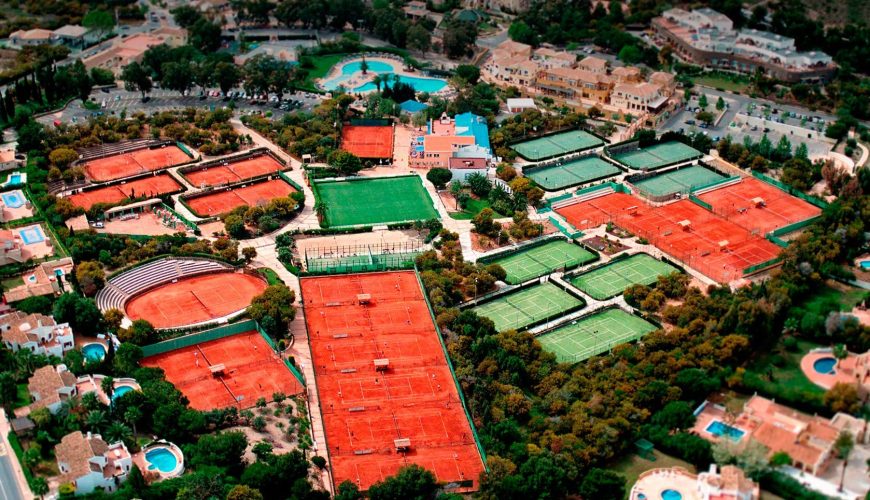
The resort’s tennis facilities centre on seven red sand courts with a full clubhouse, the main show court accommodating up to 250 spectators — a genuine tournament-standard setup that reflects the facility’s ambitions beyond recreational play. A further four synthetic grass courts with quartz sand filling are shared between the Mitsis Royal Mare and the two neighbouring Mitsis hotels — the Mitsis Cretan Village and a third adjacent property — making a combined 11 courts accessible to guests across the cluster.
Thalasso as the defining advantage
What sets the Mitsis Royal Mare apart from its neighbour (and from most tennis resorts globally) is its Thalasso Spa — a full thalassotherapy centre offering seawater-based treatments, hydrotherapy, sauna, steam bath, indoor pool and a comprehensive body treatment menu. For tennis players doing daily on-court work, access to thalasso recovery treatments is a genuine performance advantage, not a luxury add-on. This combination of serious tennis infrastructure and medically grounded spa recovery makes the Mitsis Royal Mare particularly well suited to players who want to train intensively and recover properly.
| Note on branding
When searching or booking, both ‘Mitsis Royal Mare’ and ‘Aldemar Royal Mare’ return results for the same property. For blog content and SEO purposes, using both names improves discoverability across audiences who may know the resort under either name. |
4b. Nana Golden Beach: 18 courts and the Nana Tennis & Sports Club
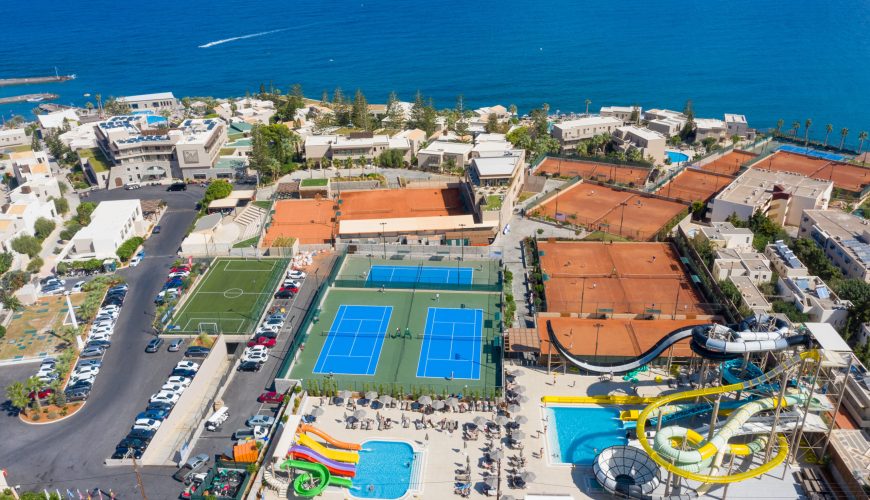
Across Anissaras, the Nana group operates a tennis facility that in sheer scale exceeds anything else on the island: 18 courts in total, of which two are covered for weather-independent play, plus dedicated padel courts. The Nana Tennis & Sports Club serves guests across three hotels: Nana Golden Beach (the largest, with seven restaurants, two indoor and seven outdoor pools), Nana Princess Suites Villas & Spa (the premium adult-oriented property) and Nana Royal (a more quietly positioned village-style hotel with its own access to tennis, squash, fitness and watersports).
18 courts: the largest tennis cluster in Crete
The scale of the Nana tennis operation is its defining feature. With 18 courts — including covered options — the facility can absorb large group bookings without ever creating pressure on court time, making it particularly well suited to club trips and group travel where multiple simultaneous matches need to be played. The two covered courts extend the playing season and allow for uninterrupted training regardless of weather, a meaningful advantage on an island where afternoon sea breezes and occasional early-season rain can interrupt outdoor play.
Coaching programmes, tournaments and clinic formats run across the season, and the resort’s all-inclusive structure (at Nana Golden Beach) makes budgeting for a tennis week straightforward. Padel courts add an increasingly popular racket-sport option for guests wanting variety, and the resort’s beach and pool infrastructure ensures non-playing companions are equally well catered for.
| Mitsis vs. Nana: which cluster suits you?
The Mitsis Royal Mare suits players who want a focused, boutique tennis experience combined with serious spa recovery — seven quality courts, a 250-seat show court and thalasso treatments in one property. The Nana cluster suits large groups, clubs and families who need maximum court availability and all-inclusive simplicity across 18 courts and three hotels. Both are within easy distance of Heraklion Airport. |
5. La Manga Club, Murcia: 26 courts alongside three championship golf courses
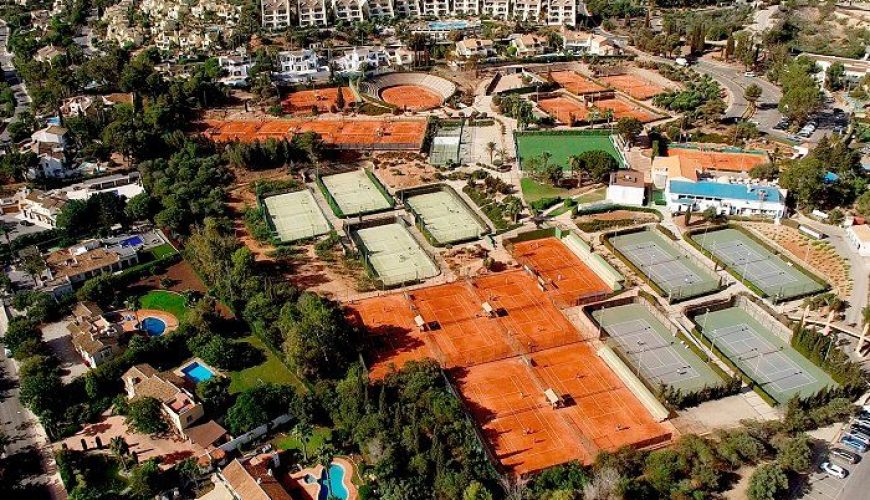
La Manga Club on Spain’s Costa Cálida is perhaps best known as a golf resort — and rightly so, with three 18-hole championship courses (the South Course having hosted the Spanish Open multiple times, the North Course weaving through natural ravines and the West Course set among pine forest with significant elevation changes). But the tennis offering at La Manga is substantial enough to merit the trip on its own terms: 26 courts, a year-round playing climate and a resort infrastructure that makes it one of the most comprehensively equipped multi-sport destinations in Europe.
26 courts in a year-round climate
With over 300 sunny days per year and a location on Spain’s warm south-eastern coast, La Manga Club offers what its Mediterranean counterparts cannot always guarantee: genuinely reliable playing conditions in the depths of winter. This makes it a natural choice for northern European clubs and groups seeking a winter or early spring training base when home courts are cold, wet or simply uninspiring. The 26 courts — a mix of clay and hard surfaces — provide ample capacity even during peak group-travel periods.
Golf and tennis under one roof
The unique appeal of La Manga Club for mixed groups is the quality of its golf offering running in parallel with the tennis. For a travelling party that includes both golfers and tennis players, La Manga is virtually unmatched in Europe: the three championship courses (South designed by Arnold Palmer, North and West by Robert Dean Putman) offer a full range of difficulty and character, while the 26 tennis courts and seven padel courts mean neither group has to compromise. Add eight football pitches, a cricket centre and the Grand Hyatt La Manga Club Golf & Spa hotel at the centre of it all, and the resort functions as a genuine multi-sport campus.
Group and corporate travel
La Manga Club has invested significantly in group and corporate travel infrastructure. A special group tennis and golf package is available for the period from November 2026 through October 2027, designed specifically for groups with a professional coach or club pro: minimum seven participants plus pro, minimum four double rooms, four to seven nights with breakfast, and three to five green fees included per person. This positions the resort as a compelling option for club trips that want to combine tennis or golf with professional coaching, without the organisational complexity of building a bespoke group package from scratch.
| Best time to visit
Spring (March to May) and autumn (September to November) offer the best balance of comfortable temperatures, competitive pricing and court availability. Winter is genuinely playable at La Manga — an important advantage over higher-altitude or northern-facing Mediterranean resorts that cool significantly from November onward. |
La Manga Club – Europe’s Greatest Sports Resort.
6. Comparing the five destinations at a glance
| Resort | Courts | Surface | Key strength | Best for |
| Forte Village, Sardinia | 13 (12 clay + 1 hard) | Clay / hard, all floodlit | FIT/ITF-certified, Grand Slam coaching, thalasso spa | Coaching-focused breaks, pre-season groups, families |
| Quinta do Lago, Algarve | Multiple indoor + outdoor | Clay | High-performance ethos, padel, Ria Formosa setting | Mixed sport groups, golf + tennis, year-round play |
| Mitsis Royal Mare, Crete | 7 sand + 4 shared synthetic | Sand / synthetic grass | Show court, thalasso recovery, boutique atmosphere | Intensive training + recovery, couples, serious players |
| Nana Golden Beach, Crete | 18 (2 covered) + padel | Clay / hard | Largest court count in Crete, all-inclusive, padel | Large club groups, families, all-inclusive simplicity |
| La Manga Club, Murcia | 26 courts + 7 padel | Clay / hard | Year-round climate, golf + tennis, group packages | Mixed golf/tennis groups, winter training, corporates |
7. Tennis travel tips: planning your perfect tennis holiday
Book courts and coaching in advance
At every resort in this guide, peak-season court time and coaching slots fill up weeks — sometimes months — ahead. This is particularly true at Forte Village, where the Tennis Academy programme has a fixed seasonal structure and visiting professional coaches draw significant demand. For group bookings at any of the five destinations, early contact with the resort’s group sales or sports booking team is essential.
Match the resort to your group
A solo player or couple seeking intensive coaching will get the most from Forte Village or the Mitsis Royal Mare, where smaller, focused environments and high coaching quality are the defining features. A large club group needs either the Nana complex (maximum court availability, all-inclusive simplicity) or La Manga Club (group package infrastructure, year-round reliability). A mixed golf-and-tennis party is almost certainly best served by Quinta do Lago or La Manga, the two resorts where both sports are genuinely world-class.
Factor in recovery
Serious tennis over multiple days takes a physical toll, particularly on clay in warm weather. Two resorts in this guide — Forte Village (Acquaforte Thalasso & Spa) and Mitsis Royal Mare (Thalasso Spa) — have invested specifically in thalassotherapy-based recovery infrastructure that is meaningfully useful for athletic recovery, not just relaxation. If daily on-court intensity is the plan, factoring in a spa treatment budget alongside court fees is worth doing.
Consider shoulder season
April to June and September to October consistently offer the best combination of playable temperatures, reduced guest numbers, competitive pricing and — at some resorts — structured tournament programmes that provide built-in playing partners and competitive context. Midsummer is hot, expensive and crowded at every Mediterranean destination in this guide. Winter is viable only at La Manga and Quinta do Lago, where the climate remains genuinely warm enough for comfortable outdoor play.
Padel is worth trying
Every resort in this guide now offers padel alongside tennis, and if you have not played it, a tennis holiday is an ideal moment to try. The learning curve is gentler than tennis (the enclosed court and smaller playing area are forgiving for beginners), the social format — always played in doubles — is naturally more interactive, and the skills transfer is significant for tennis players. Most resorts offer introductory lessons specifically aimed at tennis players making the crossover.
Whether you are chasing a week of intensive clay-court coaching under Sardinian skies at Forte Village, a pre-season group block at La Manga, a recovery-focused training week combining seven Cretan sand courts with thalasso treatments at the Mitsis Royal Mare, maximum court availability for a large club trip at Nana, or a mixed-sport week at Quinta do Lago where the Ria Formosa and three championship golf courses compete for your attention — the resorts in this guide represent the best that European tennis travel currently has to offer. Book early, pack the right shoes for clay, and make the most of the shoulder season.
Visit Sportmeeting and send your mail request: info@sportmeeting.de
Comment (0)