

Tour Mont Blanc – Guided Trekking · France · Italy · Switzerland · 2026
106 miles. Three countries. One massif. The Tour du Mont Blanc is the finest trekking route in Europe – and with a professional mountain guide, daily luggage transfer and carefully chosen accommodation, it becomes the experience of a lifetime.
March 2026 – Guided Trekking Holiday – Reading time approx. 10 min.
Why the Tour du Mont Blanc?
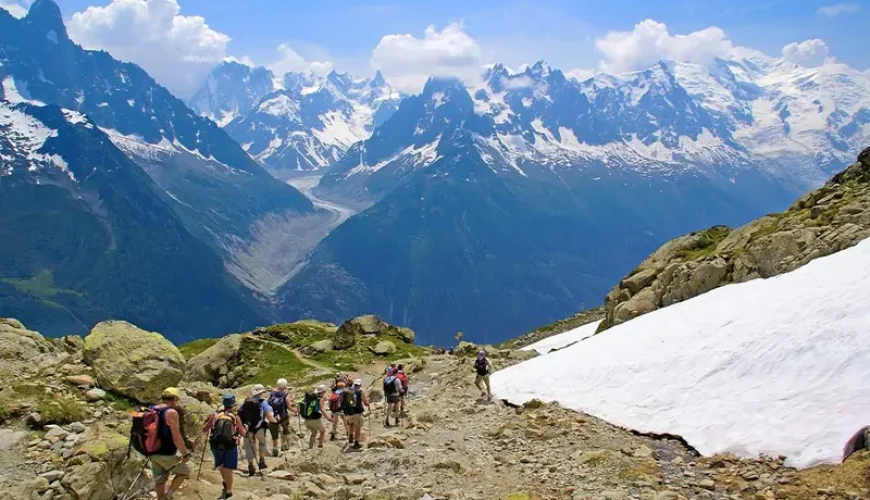
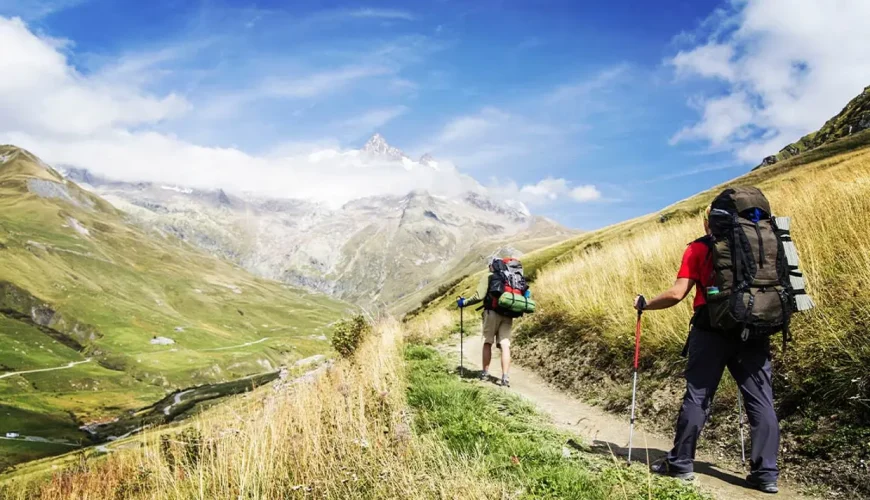
The Tour du Mont Blanc – widely known as the TMB – is no ordinary walking route. It is one of the great trekking circuits of the world: 106 miles around the Mont Blanc massif, through three countries, over passes rising to 8,500 feet, alongside glaciers and mountain lakes, across alpine meadows and rocky ridges, with constantly changing perspectives on the highest peak in the Alps. Every stage reveals a new face of the massif – and every night in a mountain hut or alpine hotel deepens the feeling of being genuinely in the mountains.
What distinguishes the Tour du Mont Blanc from other trekking routes is the extraordinary concentration of landscape, cultural and gastronomic experiences it offers. Across three countries – France, Italy and Switzerland – you walk through entirely different alpine cultures: from Savoyard cuisine in Chamonix to Italian warmth in Courmayeur to Swiss precision in the Valais villages. All of it set within a mountain landscape that has no equal in Europe.
“The Tour du Mont Blanc is worth every single step. Those who complete it want to come back and do it again immediately.”
The guided version of this classic route with sportmeeting.de offers everything a perfect trekking holiday requires: a professional mountain guide who not only navigates but explains, motivates and keeps the group safe; daily luggage transfer that frees the mind and the back; carefully selected accommodation throughout; and a group of like-minded people with whom the inevitable challenges become part of the experience.
All highlights of the guided tour
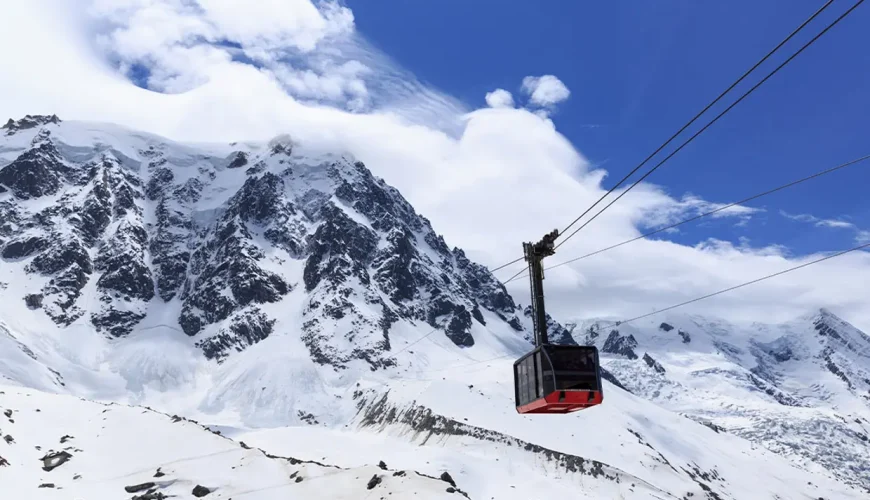
Cable Car · La Flégère
La Flégère cable car ride
The La Flégère cable car ride is the perfect opening or closing act for the Tour. From the mountain station at 6,158 feet an unobstructed panorama opens onto the Mont Blanc massif: the Mer de Glace glacier, the needle like Aiguilles de Chamonix, and in the distance the summit of Mont Blanc itself. The station is also the starting point for the ascent to Lac Blanc.
Glacier world · Chamonix
Guided walk to the Mer de Glace
The Sea of Ice – the Mer de Glace is France’s largest glacier and the most dramatic natural spectacle in the Chamonix valley. The guided walk leads to the glacier’s edge and inside the ice labyrinth: deep blue ice caves, glacier mills and an ice landscape you simply cannot experience in this way without a professional guide. An unforgettable moment for every participant.
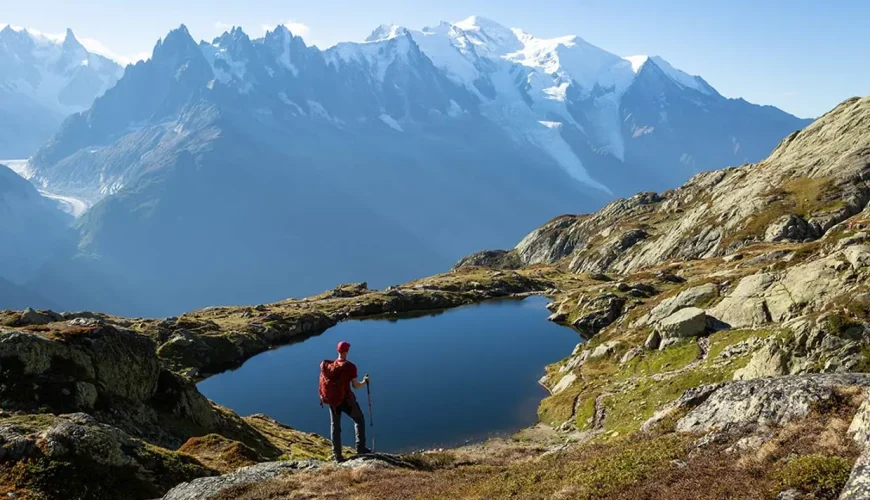
Mountain lake · 7,717 ft
Guided walk to Lac Blanc
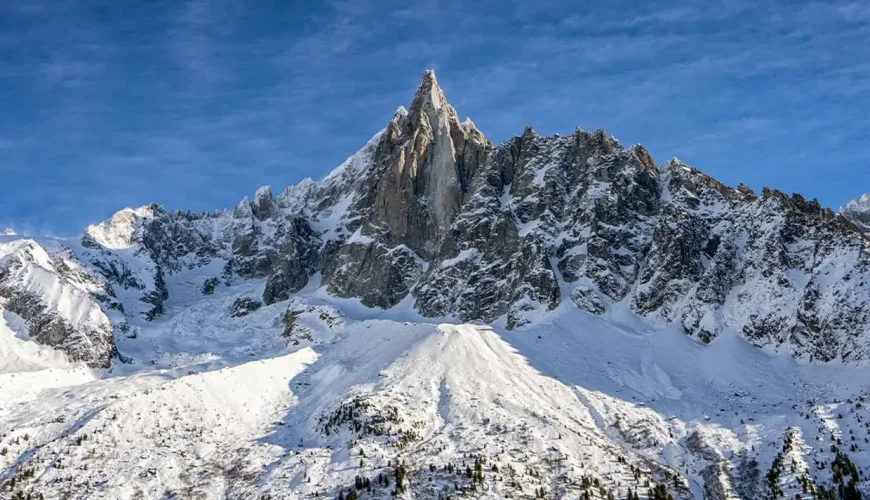
Lac Blanc at 7,717 feet is arguably the most iconic hiking destination in the entire Chamonix region: a deep blue mountain lake in which, on calm days, the entire Mont Blanc massif is mirrored. The ascent to Lac Blanc across the Aiguilles Rouges balcony is one of the finest day walks in the Alps. The view from the refuge at the lake shore – with the Aiguille Verte, Les Drus and Mont Blanc behind – is one of the great visual moments of the entire journey.
Alpage · Haute-Savoie
Bovine – guided walk
The path across the Alpage de Bovine is an insider’s favourite on the TMB: a lush high pasture on the route from the Swiss village of Trient towards Chamonix, with breathtaking views over the Rhône Valley and the Valais peaks. Traditional mountain farmers still work here according to the old rhythm of the alpine year – a rare encounter with alpine pastoral culture at its most authentic.
Pass · CH/IT border · 8,317 ft
Col Ferret – guided walk
Col Ferret at 8,317 feet (Swiss side: 8,169 feet) marks the border between Switzerland and Italy and is one of the most dramatic points on the entire Tour du Mont Blanc. From the pass you can see simultaneously into the Swiss Ferret Valley and the Italian Val Ferret – two entirely different landscapes beginning at the same ridge. The ascent and descent of Col Ferret ranks among the most demanding and most rewarding stages of the route.
Valley · Italy · Glaciers
Guided walk through the Lex Blanche valley
The Vallon de la Lex Blanche on the Italian side of the Mont Blanc massif is one of the wildest and most impressive landscapes on the entire route: a glacier valley with several active glaciers, roaring mountain streams and a mountain backdrop reminiscent of the great Himalayan valleys. The guided walk through this valley is among the most unforgettable moments of the whole journey.
Pass · F/I border · 8,251 ft
Walk over the Seigne Pass
Col de la Seigne at 8,251 feet is the crossing between France and Italy – and one of the great passes of the tour. Those who stand here have just experienced a true change of perspective: behind them the French Contamines valley; ahead the entire Val Vény with the Miage Glacier and the Mont Blanc massif in its most imposing aspect. The ascent to the Seigne Pass is physically demanding and scenically exceptional.
Mountain hut · Overnight stay
Overnight stay in a mountain refuge
A night in a mountain refuge along the Tour du Mont Blanc is one of the indispensable experiences of this journey. Dormitory or multi-bed rooms, a kitchen that produces astonishing food from simple ingredients, walkers from around the world at the evening table, the light of head torches when rising before dawn – refuge life follows a different rhythm to the world below. On most mountain huts cash only; shower tokens can be purchased at the refuge.
Passes · 7,644 ft / 8,127 ft
Guided walk – Col du Bonhomme and Croix du Bonhomme
The Col du Bonhomme (7,644 ft) and Croix du Bonhomme (8,127 ft) are the great passes of the French section – the crossing from the Contamines valley into the high Tarentaise mountains. From the Croix du Bonhomme opens one of the widest panoramas on the entire TMB: Belledonne, the Vanoise, the Graian Alps – a 360-degree view across the heart of the French Alps.
Hamlet · Haute-Savoie
The hamlet of Gruvaz
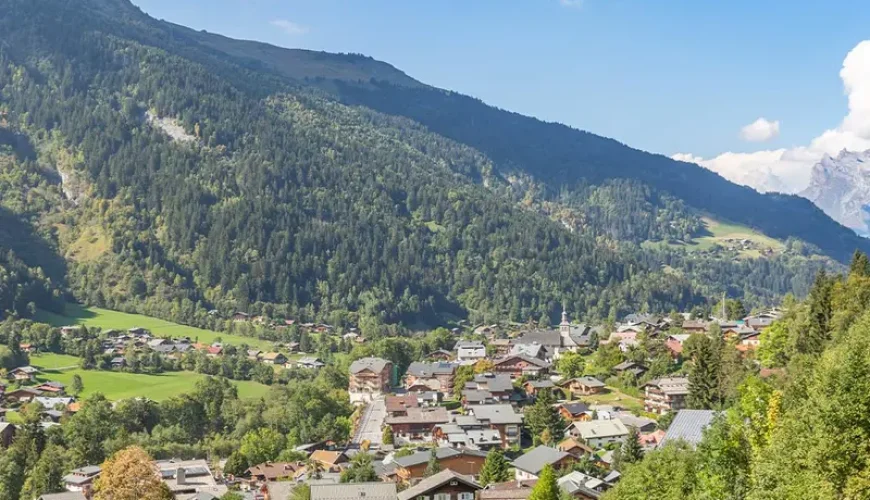
The hamlet of Gruvaz is one of those small, often overlooked places that constitute the heart of rural alpine France: a handful of ancient stone buildings, mountain farming, a chapel, a fountain – and the absolute stillness of a valley that tourism has not yet fully discovered. The guided walk past Gruvaz is a moment of stillness within the larger adventure of the tour.
Glacier · Aiguille de Bionnassay
Champel and Bionnassay – guided walk
The walk through the Champel and Bionnassay area brings walkers within immediate reach of the Bionnassay Glacier, flowing down from the Aiguille de Bionnassay (13,294 ft). The famous suspension bridge over the glacier outflow is one of the most spectacular and most photographed moments of the entire Tour du Mont Blanc – those who cross this swaying bridge above the roaring glacial stream understand immediately why this route has become a legend.
Pass & Gondola · 5,424 ft
Walk to Col de Voza and Bellevue gondola ride
Col de Voza (5,424 ft) is the vantage point for some of the finest views of the Mont Blanc south-west ridge and the Aiguille de Bionnassay. The subsequent ride on the Bellevue gondola offers a relaxed conclusion after a long walking day – and a viewpoint from which the entire massif can be seen in its full breadth.
Tour character and fitness profile
The Tour du Mont Blanc is not a stroll – but neither is it an extreme adventure. It is a demanding trekking route that can be completed by physically well-prepared walkers with mountain experience. The most important factor is realistic self-assessment and thorough preparation beforehand.
Fitness and technical requirements
- Fitness requirement:Up to 4,000 feet of ascent and descent per day · Daily stages of up to 9 hours of walking time · Walking intervals of 2 hours without a break
- Technical requirement:Predominantly straightforward and moderate, occasionally demanding mountain paths · Snow fields and short secured sections may be encountered · Rocky terrain, scree fields and boulder ground are possible · Surfaces can be slippery depending on weather conditions
- Prerequisites: Freedom from vertigo, sure-footedness and prior mountain experience are essential
- Altitude: Between 4,921 ft and 8,500 ft throughout
- Group size: 6 to a maximum of 12 participants
- Guiding: Professional mountain guide on all stages
Luggage transfer and logistics
One of the greatest practical advantages of this guided tour is the daily luggage transfer: one piece of luggage per person, with a maximum weight of 20 kg (44 lbs), is transported each day from the current to the next accommodation. You carry only your day pack on the trail – water, rain jacket, snacks and essentials – while your main luggage waits for you at the next refuge or hotel.
This service transforms the Tour du Mont Blanc fundamentally. Anyone who has ever climbed over Col Ferret or the Croix du Bonhomme with a 33 lb rucksack knows: the luggage transfer is not a luxury, it is the key to genuinely enjoying the landscape of the route – rather than suffering under the weight of your own gear.
Luggage transfer details
- Pieces: 1 piece per person
- Maximum weight: 20 kg (44 lbs) per piece
- Packaging: Main luggage must be suitably packaged for transport (no open-frame backpacks)
- Day pack: Each participant additionally carries a small day pack (approx. 25–35 litres) for water, food, rain gear and daily essentials
- Mountain huts: On refuge nights, accommodation is in dormitories or multi-bed rooms – private double rooms are not available on most mountain huts
- Payment at huts: Cash only on most mountain huts (euros) – shower tokens can be purchased at the refuge
Optional highlights – Aiguille du Midi and Alpine Museum
Aiguille du Midi cable car – above the clouds
The Aiguille du Midi (12,605 ft) is one of the most extraordinary viewpoints in the Alps – and the cable car from Chamonix to its summit is one of the most spectacular mountain railway journeys in the world. In two stages the cable car climbs from 3,396 ft to 12,605 ft in less than 20 minutes. At the top you stand in the high alpine zone: permafrost, glacier ice, snow in August, and a 360-degree panorama extending from Mont Blanc to the Matterhorn. The glass viewing cabin «Pas dans le vide» («Step into the Void») hangs freely at 12,605 ft above the abyss – an experience that is not for everyone, but for all who do it, absolutely unforgettable.
The Aiguille du Midi trip is an optional activity recommended before or after the main tour. Bookings directly with Compagnie du Mont Blanc; advance reservation is strongly recommended, particularly in high season.
Alpine Museum Chamonix
The Musée Alpin de Chamonix on Rue Michel-Croz traces the history of Mont Blanc and the exploration of the Alps from the 18th century: the first ascent by Balmat and Paccard in 1786, the pioneers of alpinism, the history of the Chamonix valley and the development of mountain guiding as a profession. For participants who wish to add a historical and cultural dimension to their mountain experience, the museum is an invaluable visit.
Equipment recommendation – LOWA hiking boots for the TMB
No piece of equipment matters more on the Tour du Mont Blanc than the walking boot. Across 106 miles, with up to 33,000 feet of ascent and descent combined, on rocky ground, through snow fields and across slippery scree – the boot carries you through all of it. The wrong boot can turn the finest trekking route in Europe into an ordeal. The right boot lets you forget about your feet and concentrate on the mountains.
LOWA – the Bavarian company from Jetzendorf with decades of Alpine heritage – is the quality benchmark in mountain footwear. Handcrafted in Europe on a last developed for alpine terrain, with quality control that accepts no compromise, LOWA boots are the first choice of experienced mountain guides and TMB veterans alike.
LOWA recommendations for the Tour du Mont Blanc
- LOWA Tibet GTX:The benchmark boot for serious multi-day trekking – ankle-height shaft, GORE-TEX membrane (waterproof and breathable), Vibram outsole with outstanding grip on rock and scree. The ideal all-rounder for the TMB. Category B/BC.
- LOWA Renegade GTX Mid:For lighter-footed walkers who prioritise comfort and flexibility – slightly lighter than the Tibet, mid-height shaft and full GTX specification. Suitable for participants with existing experience of long trekking stages.
- LOWA Mountain Expert GTX EVO:For the most ambitious mountain walkers – those who also want to be prepared for the more technically demanding sections (snow fields, secured passages). Stiffer shaft, maximum support, crampon-compatible.
- Breaking-in advice:Wear the new boot on demanding walks for at least 8–10 weeks before the tour. Buy from a specialist retailer with personal fitting and gait analysis. Pair with high-quality hiking socks – no cotton; merino wool is recommended.
- Find a LOWA retailer:lowa.de/de-de/store-finder
Recommended kit list for the guided TMB
Footwear and clothing
Ankle height mountain boots Cat. B/BC (e.g. LOWA Tibet GTX) · Hiking trousers (light or convertible) · Moisture-wicking base layer · Fleece or PrimaLoft jacket · Waterproof hardshell jacket and trousers · Warm hat and gloves · Sun hat with brim
Pack and safety
Day pack approx. 25–35 l with rain cover · First aid kit · Sunscreen and lip protection (high SPF) · Sunglasses (UV-400 or Category 4 for snow fields) · Trekking poles strongly recommended · 1.5–2 litres of water per day · Head torch with spare batteries
Hut essentials
Sleeping bag liner (recommended) · Cash in euros (card payment rare at mountain huts) · Passport or national ID card · GHIC card (UK travellers) or EHIC (EU travellers) · Travel insurance with mountain rescue cover
Navigation and communication
Walking map or TMB GPS app · Charging cable and power bank · Offline map on smartphone · Emergency numbers: 112 (general Europe), 15 (France medical emergency), 1414 (Swiss Air Rescue REGA)
Hotels in Chamonix – before and after the tour
Chamonix is the base for the Tour du Mont Blanc – the natural starting point and the finish, where you return after the trekking. For nights before and after the tour we recommend the hotels available through chamonix.de – the information portal for the Chamonix region.
Hotel recommendations Chamonix – chamonix.de
- chamonix.de: The complete hotel selection for Chamonix – from comfortable 3-star mountain hotels to 5-star addresses in the town centre: chamonix.de
- Location recommendation: Hotels in central Chamonix (town centre, walking distance to the railway station and cable car stations) are most practical for the tour
- Night before the tour: An arrival night in Chamonix is strongly recommended – travel relaxed, check equipment, acclimatise to the altitude
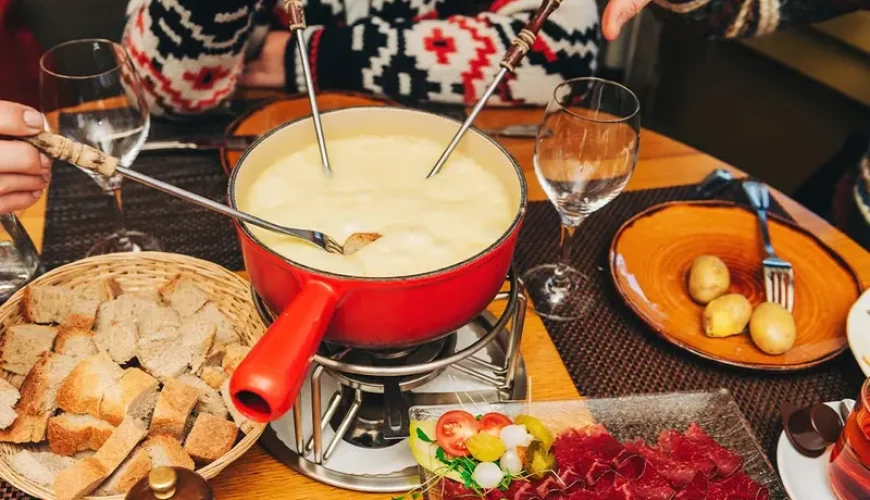
- Night after the tour: One final night in a Chamonix hotel allows time for the adventure to settle, a last walk along Rue du Mont-Blanc and a well-deserved Savoyard dinner
- Booking tip: Book early in summer – Chamonix fills quickly in season, particularly during the UTMB week at the end of August / beginning of September
Chamonix – the town beneath the mountain
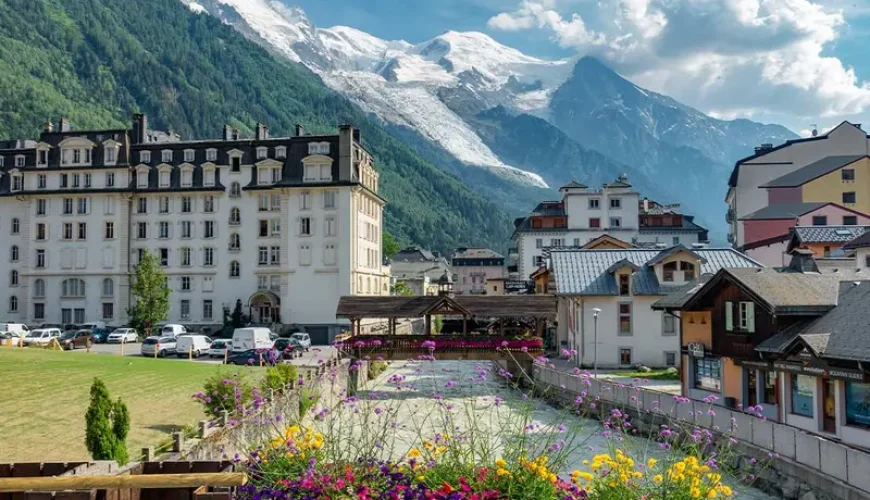
Chamonix-Mont-Blanc (3,396 ft, approx. 10,000 residents) is not merely the starting point for the Tour du Mont Blanc – it is one of the most vibrant and beautiful mountain towns in the world. The pedestrianised Rue du Mont-Blanc with its outdoor equipment shops, restaurants and cafés; the quieter district of Les Praz; the elegant town centre; and everywhere the view of the white walls of the Mont Blanc massif: Chamonix is motivation before the tour and reward after it.
Arriving a day or two before the tour allows time for acclimatisation at altitude (3,396 ft), and gives you the opportunity for initial cable car rides, a visit to the Alpine Museum and the finest mountain equipment shops in the Alps – including several authorised LOWA retailers.
Getting to Chamonix
Travel options from the UK and beyond
- Flight + shuttle (fastest): Fly to Geneva (GVA) – then a direct shuttle transfer to Chamonix (approx. 1 hour 15 minutes). The quickest and most convenient option. Shuttle services available directly from Geneva Airport arrivals. Multiple daily flights from London Heathrow, Gatwick, Manchester and Edinburgh with British Airways, easyJet and Swiss.
- Train (most scenic): Eurostar to Paris, then TGV to Saint-Gervais-les-Bains and the narrow-gauge Mont Blanc Express to Chamonix. Or Eurostar to London, then connection via Paris to Geneva and onward by train. Excellent option for those wishing to avoid flying.
- Car: Chamonix is served via the Mont Blanc Tunnel (from Courmayeur, Italy) and via the A40 motorway from France. Parking in Chamonix is limited and charged – underground car parks are recommended.
- From the UK by coach: Eurolines and FlixBus operate services from London to Geneva; onward by shuttle or bus to Chamonix. The longest but cheapest option.
- Nearest airports: Geneva (GVA, 56 miles), Lyon Saint-Exupéry (LYS, 112 miles), Milan Malpensa (MXP, 137 miles)
- London to Chamonix flight time: approx. 1 h 30 min (to Geneva GVA); then approx. 1 h 15 min by shuttle
Booking and information
The guided Tour du Mont Blanc with daily luggage transfer, professional mountain guide and all highlights listed above is booked directly through sportmeeting.de. Full details of the tour, available dates, pricing and the complete kit list are on the official tour page.
At a glance
- Booking and full details: sportmeeting.de/TourDetails/details/Mzc5MA==
- Luggage transfer: Included – 1 piece per person, max. 20 kg (44 lbs)
- Mountain guide: Professional guide on all stages
- Group size: 6–12 participants
- Accommodation: Mountain huts (dormitories/multi-bed rooms) and mountain hotels depending on the stage
- La Flégère cable car: Included
- Hotels in Chamonix before/after: chamonix.de
- Optional activities: Aiguille du Midi cable car · Alpine Museum Chamonix
- Three countries: France, Italy, Switzerland
“The Tour du Mont Blanc is the experience I tell my children about. Not because it was easy – because it made me better.”
Your Mont Blanc adventure awaits
Around the King of the Alps – guided, comfortable, unforgettable.
Daily luggage transfer included. Professional mountain guide. La Flégère cable car included. Places are limited – book yours directly at sportmeeting.de.
Comment (0)